Boie's Frog
Proceratophrys boiei
 AI-generated
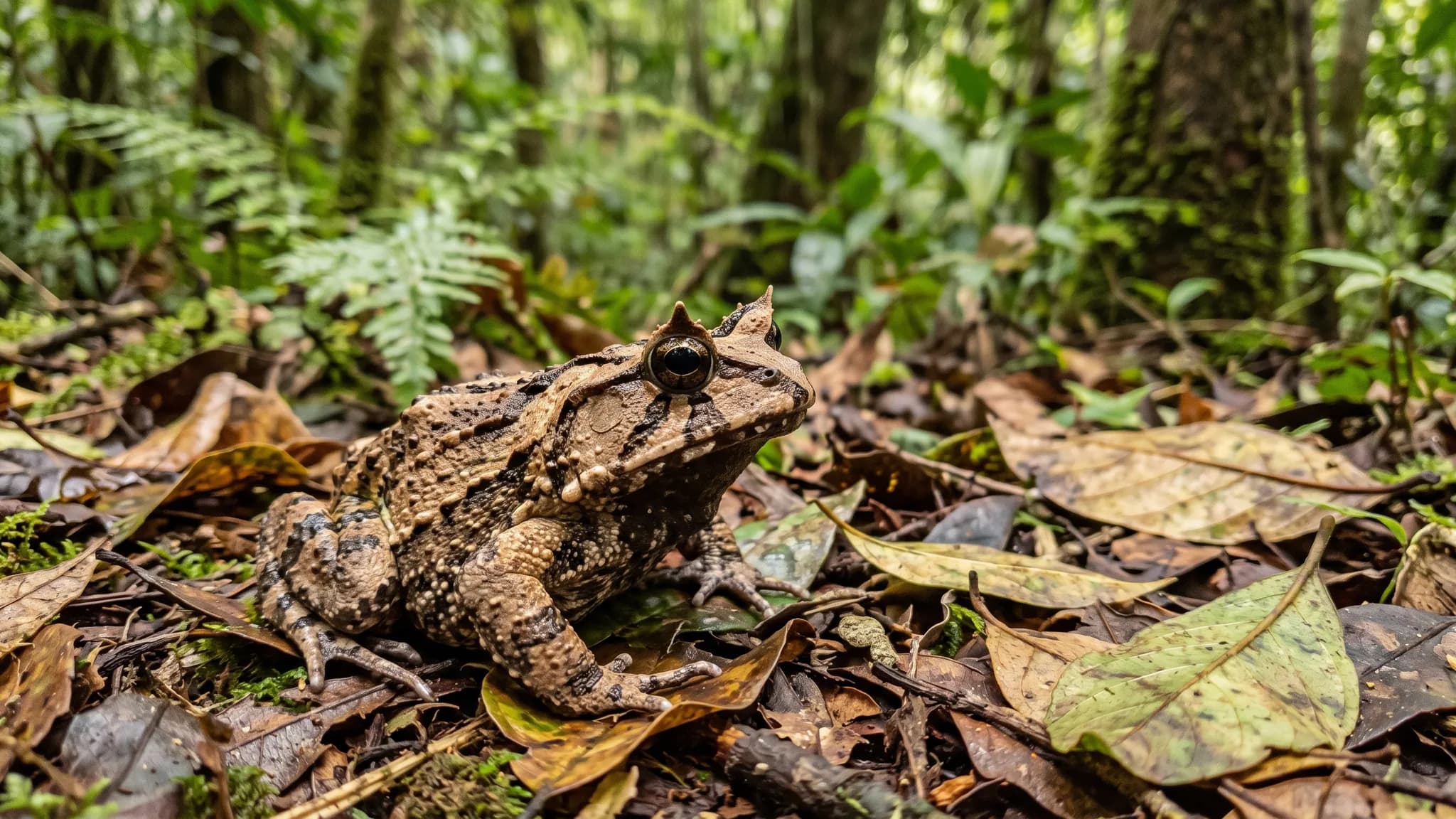
A Boie's Frog resting on dry leaf litter in a forest environment, displaying its cryptic coloration, warty skin, and characteristic horn-like projections above its eyes.
Proceratophrys boiei, commonly known as Boie's frog or the Rio de Janeiro smooth horned frog, is a moderate-sized amphibian belonging to the family Odontophrynidae. Endemic to eastern and southeastern Brazil, this frog is best known for its remarkable leaf-like camouflage and distinct physical adaptations. The specific epithet honors either Heinrich Boie or his brother Friedrich Boie, prominent German zoologists. Recent taxonomic revisions have refined the delimitation of the species using mitochondrial DNA and comparative morphology to differentiate it from closely related taxa.
The species exhibits a robust, broad head and stout body, with a snout-to-vent length ranging from 40 to 62 millimeters in males and up to 74 millimeters in females. The skin on its back and flanks is heavily textured with warts. Its most defining feature is the presence of long, tapering, fleshy horn-like flaps of skin projecting from above the upper eyelids. Its cryptic coloration consists of an irregular geometric pattern combining hues of brown, black, yellow, orange, and red, frequently accented by a broad brown or gray dorsal stripe. When threatened, P. boiei exhibits a highly specialized defensive behavior: it flattens its body against the ground and stiffens its limbs outward, perfectly mimicking a dead leaf to evade detection.
Proceratophrys boiei is widely distributed across the Brazilian states of Espírito Santo, Minas Gerais, Rio de Janeiro, São Paulo, Paraná, and Santa Catarina. It primarily inhabits the Atlantic Rainforest and transitional zones reaching into the Cerrado biome, ranging from sea level up to elevations of 1,200 meters. The frog is strictly terrestrial, predominantly found nestled in the leaf litter of primary and secondary woodlands, along forest edges, and in proximity to narrow, permanent, slow-flowing streams or swamps.
The diet of P. boiei is strictly insectivorous and relies heavily on ground-dwelling arthropods. Analyses reveal that beetles (Coleoptera) and grasshoppers or crickets (Orthoptera) comprise the vast majority of its prey volume. Researchers have observed a positive correlation between the body size of the frog and the volume of prey it consumes. Because of its diet, it plays a meaningful role in controlling forest invertebrate populations. Additionally, the species serves as a vital model organism for amphibian sex chromosome evolution, possessing a uniquely high amount of satellite DNA and a highly heterochromatic metacentric 'W' sex chromosome in females.
Reproduction aligns with the regional rainy season, peaking between September and January. Males call to females at night from the ground or near slow-flowing forest streams utilizing a single internal vocal sac, and eggs are deposited directly into adjacent swamps or streams. The IUCN assesses Proceratophrys boiei as a species of 'Least Concern' due to its broad geographic range and large, stable populations. Nevertheless, it faces localized threats from habitat fragmentation driven by agriculture, wood plantations, livestock grazing, human settlement, and occasional harvesting for the illegal exotic pet trade.