Queen Angelfish
Holacanthus ciliaris
 AI-generated
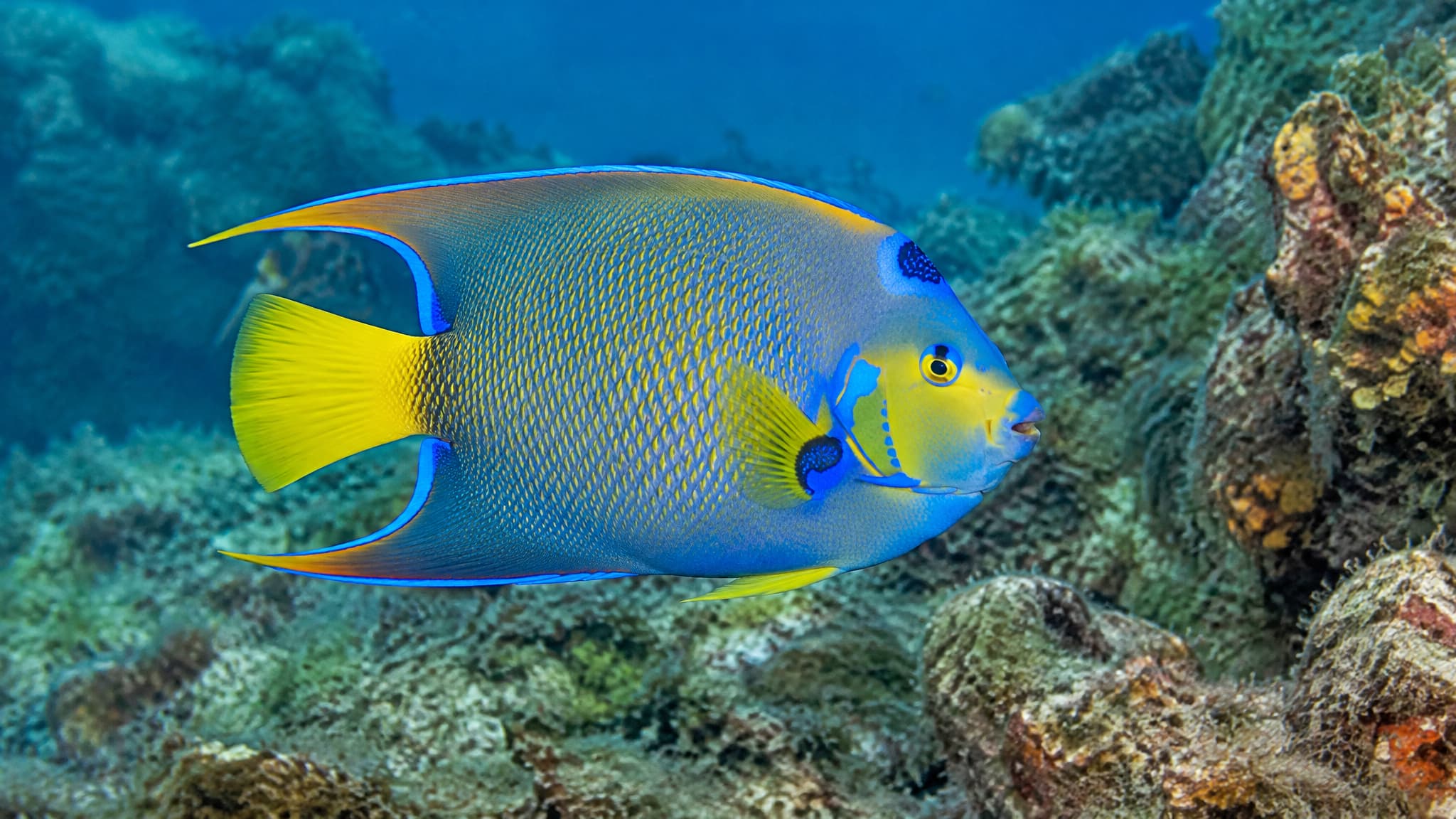
A Queen Angelfish swims in side profile above a coral reef, showing its vivid blue-and-yellow body, yellow tail, blue-edged fins, and blue crown-like marking on the forehead.
Queen angelfish
The queen angelfish is a large, deep-bodied marine reef fish with a strongly compressed, oval profile and long trailing dorsal and anal fins. Adults are vivid blue to bluish-green, with yellow-orange edging on many scales, a completely yellow tail, and a conspicuous dark forehead spot encircled and speckled with electric blue—the crown-like marking behind its common name. It can reach about 45 cm in total length. Juveniles look markedly different: they are darker blue with curved pale-blue and yellow bars, a pattern that helps distinguish young fish from adults.
This species inhabits warm western Atlantic waters, ranging from Florida, Bermuda, and the Gulf of Mexico through the Caribbean to southern Brazil; it also occurs around Saint Peter and Saint Paul Rocks. It is associated with coral reefs and other structurally complex hard-bottom habitat, from shallow water to roughly 70 m deep. Individuals usually move alone or in pairs among corals, sea fans, sea whips, and sponges.
Queen angelfish feed chiefly on sponges, supplemented by tunicates, hydroids, bryozoans, algae, plankton, and other small reef invertebrates. This specialized feeding makes them part of the ecological network that regulates sponge growth on reefs. Juveniles may establish cleaning stations, where they remove external parasites from larger fishes. Adults in turn may be eaten by larger reef predators.
Spawning is external: pairs rise into the water column and release eggs and sperm, with no subsequent parental care. Eggs hatch quickly, usually within about a day, and planktonic larvae later settle on reefs after several weeks. Courtship groups may include a male and several females. A well-supported maximum lifespan has not been established in the sources reviewed.
The species is assessed as Least Concern globally. It is collected for the aquarium trade and, in some places, for food; degradation of coral-reef habitat can also affect local populations. Its dependence on healthy reef communities makes reef protection important even though the species is not currently considered globally threatened.