Red-tailed black shark
Epalzeorhynchos bicolor
 AI-generated
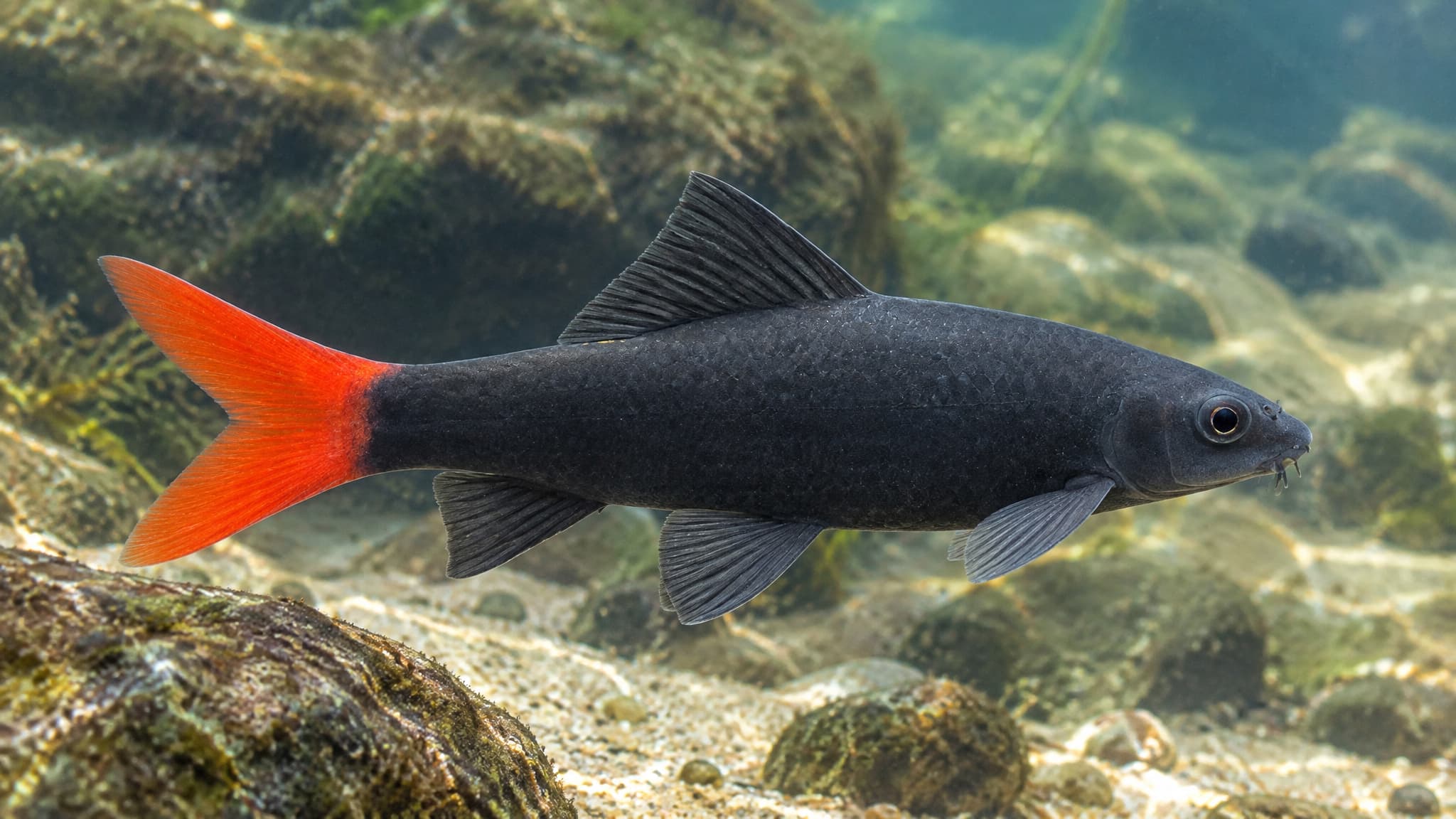
A red-tailed black shark swims in profile over a rocky, gravel-bottomed aquatic habitat, showing a dark body, vivid red tail, tall dorsal fin, and visible mouth barbels.
The red-tailed black shark is not a shark at all but a member of the carp family, Cyprinidae. It has an elongated, slightly compressed body that is velvety black, a tall triangular dorsal fin and a forked tail fin of bright red. The snout overhangs a downward-facing mouth with two pairs of barbels, an arrangement suited to grazing on surfaces. FishBase records a maximum of 13.0 cm total length, while aquarium fish typically reach about 16 cm. Females tend to be larger and fuller, and males slimmer with a more pointed dorsal fin.
The species is endemic to Thailand, where it has been recorded from the lower Mae Klong, Chao Phraya and Bang Pakong river basins. It lives in lowland rivers, streams and floodplains, favouring clear, flowing water over sand and rocks. Hugh McCormick Smith described it in 1931 as Labeo bicolor, a name still widely used in the aquarium hobby.
In the wild it is mainly a bottom-dwelling grazer of aufwuchs, the film of algae and tiny organisms that coats rocks, and it also takes small crustaceans, insect larvae, worms, detritus and plant matter. It is an active, mostly nocturnal swimmer and a good jumper. With age it becomes strongly territorial, especially towards its own kind and similar-looking fish, so in aquariums it is usually kept alone.
It is an egg layer, but spawning in home aquariums is practically unknown. Commercial farms in Thailand and elsewhere breed it with hormone injections, and every fish in the trade today is captive bred. In captivity it usually lives about 5 to 8 years, and some sources report individuals living more than 15 years.
The red-tailed black shark is listed as Critically Endangered by the IUCN. It was believed extinct in the wild from 1996 until 2011, when a small population was found in the Chao Phraya basin, and a single specimen was later collected in the Mae Klong system. Dam building, swamp drainage, road construction, pollution and siltation have degraded its habitat. Collection for the aquarium trade was once blamed for its decline, though this is debated.
Ideal water
The water this fish does best in, as kept in aquariums.
- Water type
- Freshwater
- Temperature
- 22–26 °C
- pH
- 6.5–7.5
- neutral
- General hardness
- 2–15 dGH