Ringed caecilian
Siphonops annulatus
 AI-generated
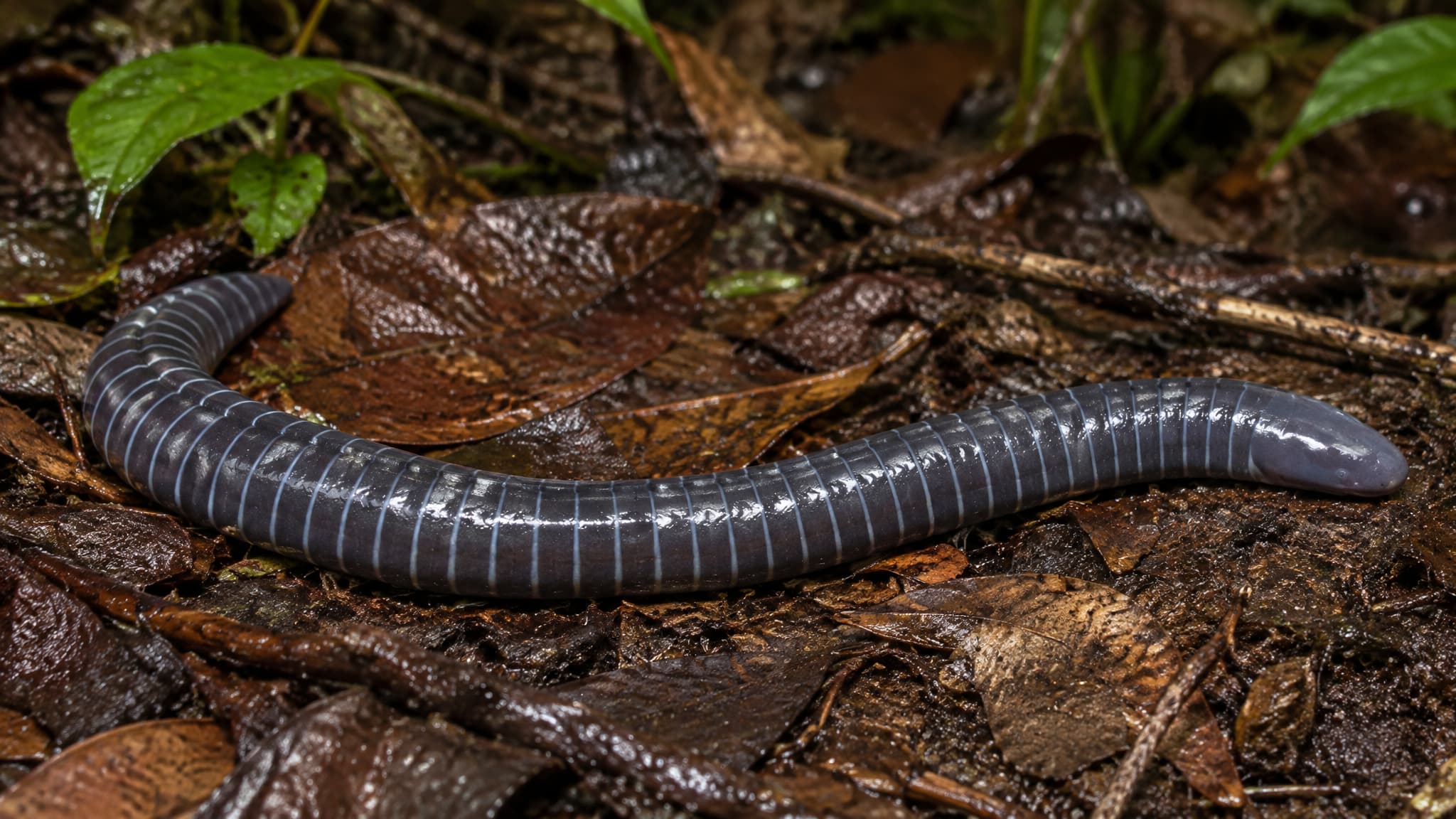
A dark, ringed caecilian lies in a broad curve across wet leaf litter, with its blunt head visible at the right. Its smooth cylindrical body shows numerous pale transverse annuli.
The ringed caecilian (Siphonops annulatus) is a legless, burrowing amphibian of the order Gymnophiona and the family Siphonopidae. Although it looks like a large earthworm or a small snake, it is more closely related to frogs. Adults reach 286–450 mm in total length. The body is cylindrical and slightly wider than it is deep, bluish-black to slate in colour, and circled by annular grooves edged in white or cream, which give the species its name; only the last 3–4 grooves near the rear do not encircle the body. A heavily ossified skull works as a digging tool.
It may have the broadest known range of any terrestrial caecilian, spreading across South America east of the Andes. It was first described from Brazil and is also reported from Argentina, Bolivia, Colombia, Ecuador, French Guiana, Guyana, Paraguay, Peru, Suriname and Venezuela. It lives in moist lowland forest, dry and moist savanna, shrubland, seasonally flooded grassland and even pastures, plantations, rural gardens and degraded former forest. In southern Bahia it is abundant in cabruca cacao plantations, where native shade trees keep the leaf litter cool, humid and rich in organic matter.
The species spends most of its life underground; tunnels studied in the field reach no deeper than 20 cm. It feeds on invertebrates that live in the soil. Glands in the head release a lubricating mucus that may help it burrow, while glands concentrated in the tail region hold noxious chemicals, much like the poison glands of toads and newts. Venom glands in the lip region release secretions onto the teeth, so a prolonged bite may deliver toxins to prey or attackers.
It lays eggs. In a long-term study population, mating took place from late August to early October, egg-laying in November and December when rainfall peaks, and hatching from late December to early January. The young hatch in an undeveloped state and feed on their mother's specially thickened outer skin, a behaviour called maternal dermatophagy, peeling it off with special teeth. A 2024 study in Science, based on 242 hours of film of 16 mothers from cacao plantations in Bahia, showed that they also drink a thick, fat- and carbohydrate-rich fluid from the mother's cloaca and make high-pitched clicks before feeding. The full cycle of maternal care, from egg-laying to independent young, lasts about 3 months. Adult lifespan has not been documented.
As a common soil predator it is part of the underground food web of forests and agroforests. The IUCN lists it as Least Concern, and no major threats to the species are known. Researchers note that its survival in southern Bahia is closely tied to keeping traditional shaded cacao farming, which has made the region one of the best natural laboratories for studying caecilians.