Greenbeak parrotfish
Scarus trispinosus
 AI-generated
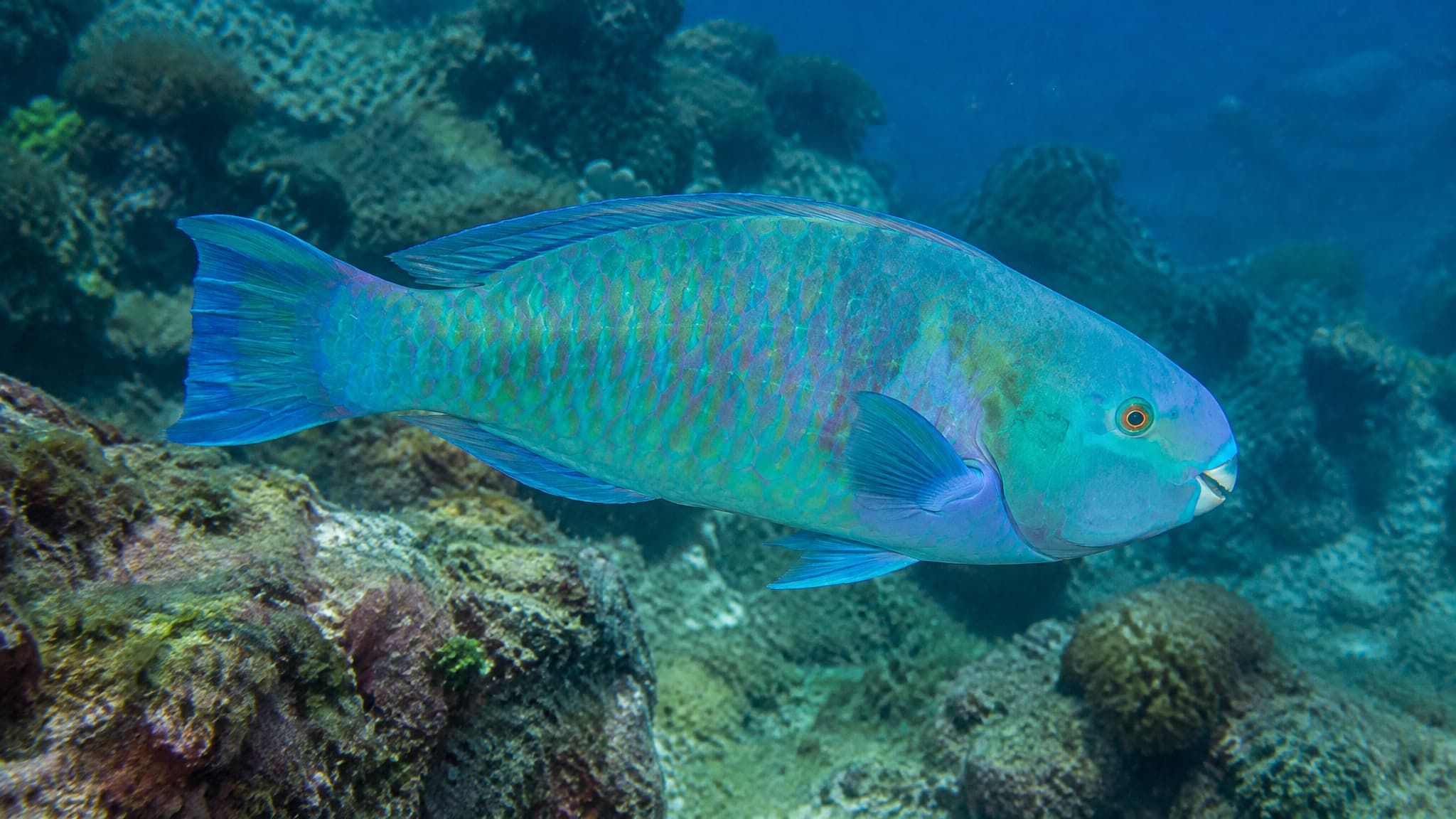
A greenbeak parrotfish swims from left to right above a coral reef, showing a robust blue-green body, overlapping scales, broad fins, and a prominent beak-like mouth.
The greenbeak parrotfish is a large, robust-bodied Brazilian parrotfish and the largest herbivorous reef fish of the South Atlantic. Adults are generally blue-grey to dark blue, with blue fins, large scales, and a blue-green fused dental plate that gives the species its English name. Adult tail lobes become elongated, while juveniles resemble adults but show a yellowish area across the nape. It can be distinguished from the similar midnight parrotfish, Scarus coelestinus, by its more uniformly coloured flank scales and lack of a broad pale-blue throat-to-snout patch.
This fish is endemic to Brazil in the southwestern Atlantic. Its principal range extends along the continental coast from Maranhão south to Santa Catarina, with the Abrolhos Bank holding an especially important remaining concentration. It uses shallow and deeper coastal reef systems, including coral, rocky, and algal reefs and algal beds. Smaller fish are associated chiefly with shallow inshore reefs, whereas larger, older fish are more frequent on deeper offshore reefs.
Like other parrotfishes, it feeds primarily by grazing and scraping algae from hard reef surfaces with its beak-like teeth. This herbivory helps limit algal growth and can reduce competition between algae and reef-building corals. The species is chiefly active by day and may occur in groups; its feeding also contributes to reef bioerosion and the movement of carbonate sediment.
It is an egg-laying fish that forms distinct breeding pairs. Research from Brazil indicates year-round reproduction with seasonal peaks, and individuals may not mature until roughly four years old. Longevity is high for a parrotfish: recorded ages reach about 22 years, making the species particularly slow to replace when large adults are removed.
The greenbeak parrotfish is globally listed as Endangered. Heavy fishing pressure, including the selective removal of large individuals, is its major documented threat; habitat degradation compounds that pressure. Protecting nursery habitat alone is insufficient, because the species also depends on deeper reefs that support older and reproductive fish. Fisheries rules and local management plans in Brazil therefore remain important conservation tools.