Spotted scat
Scatophagus argus
 AI-generated
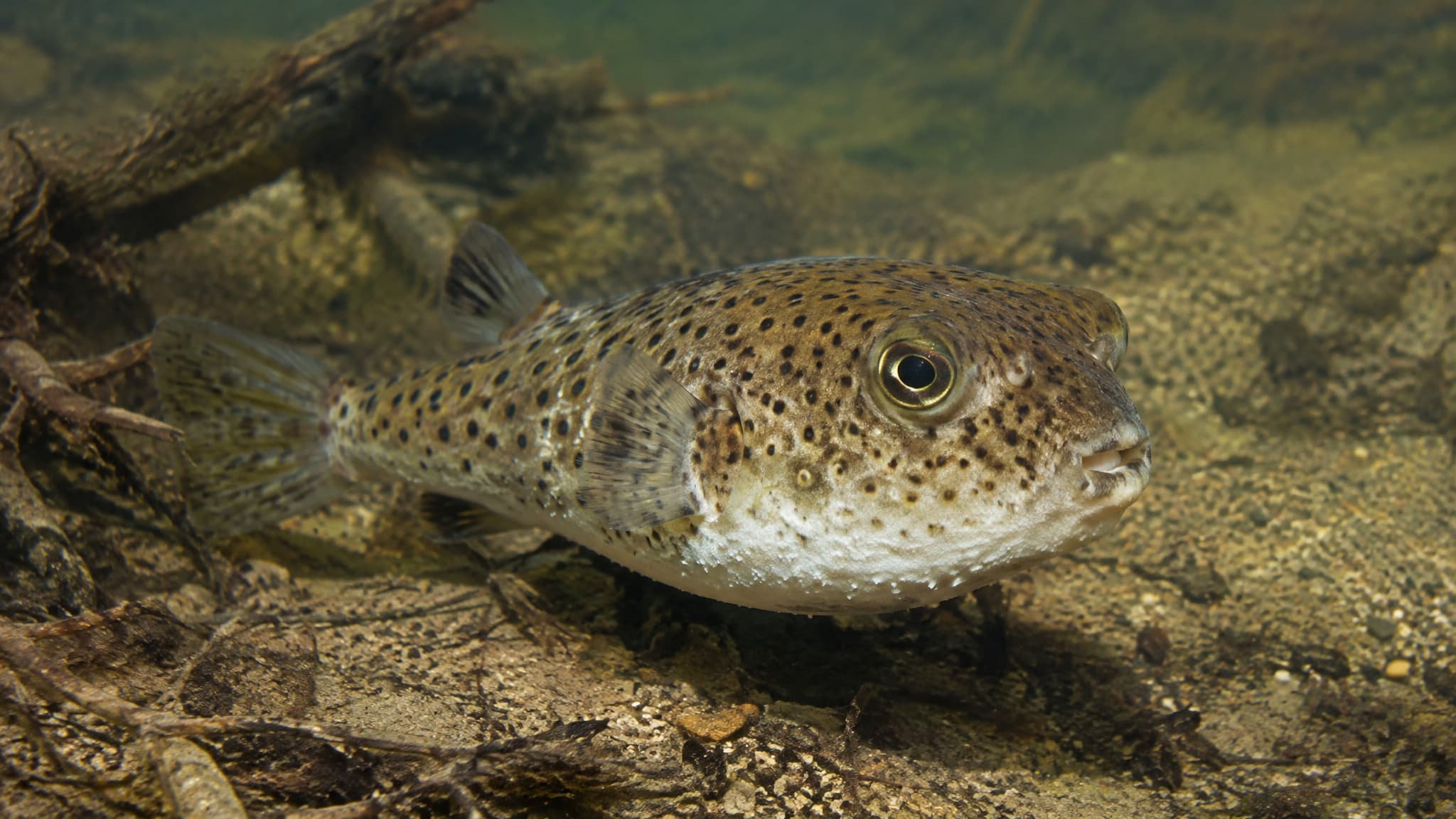
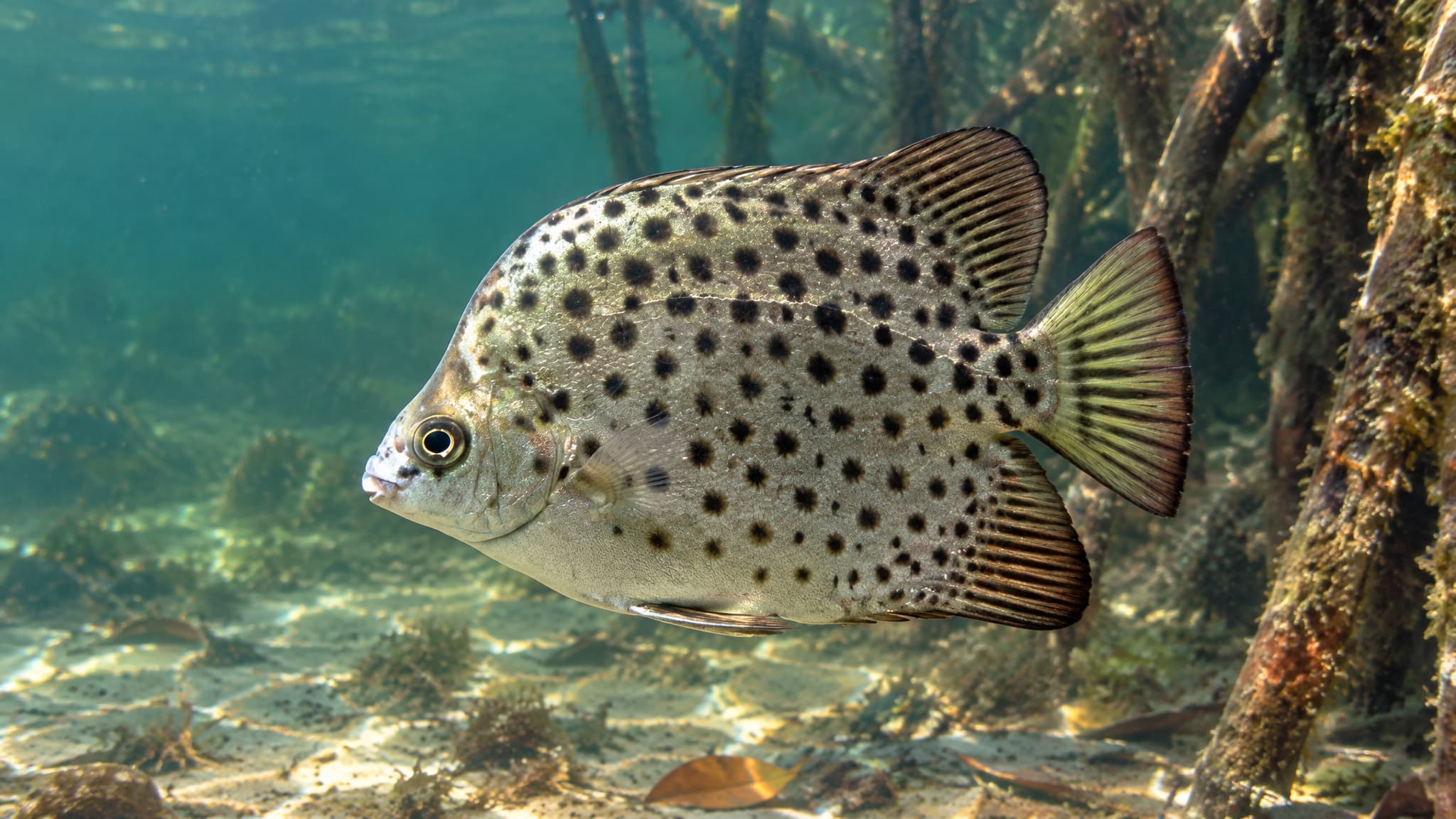
A spotted scat is shown in left-facing side profile, swimming over a shallow sandy bottom in clear water beside submerged tree roots. Its deep, laterally compressed body has numerous dark spots, tall fins, and a rounded fan-shaped tail.
The spotted scat (Scatophagus argus) is a deep-bodied, strongly compressed fish of the family Scatophagidae, with an almost rectangular outline and a steep forehead. Adults are greenish-brown to silvery, often with a golden sheen, and are covered in brown to reddish-brown spots that can fade in very large fish. Juveniles look different, with a few large dark blotches or five or six broad vertical bars. Most adults are about 20 cm long, and the largest recorded fish reached 45 cm in total length. Aquarists know two colour forms, the green scat and the ruby or red scat.
The species ranges widely across the Indo-Pacific, from Kuwait and the Persian Gulf along the coasts of South Asia to southern Japan, northern Australia, New Caledonia and Fiji, with records as far east as Samoa, Tonga and the Society Islands. It lives in sheltered, shallow water from the surface to about 5 m deep: harbours, bays, brackish estuaries, mangrove creeks and the lower reaches of freshwater streams. FishBase classes it as amphidromous, moving between fresh and salt water during its life.
Scats are indiscriminate omnivores. Their wild diet includes algae, plant matter, detritus, worms, crustaceans, insects and other small bottom-dwelling invertebrates. A study in the Philippines found adults mostly herbivorous and juveniles preferring zooplankton. Despite the name, which means "dung eater", diet studies have not confirmed that they feed on offal. Adults gather in schools, while tiny juveniles are solitary and float in the surface film.
Spawning in the Philippines is triggered by the monsoon rains of June and July, and the species spawns several times. Females mature at about 7 to 9 months and around 150 g, and males mature at a smaller size. The eggs are about 0.7 mm across, the larvae hatch about 20 hours after fertilisation at 1.8 mm long, and the young pass through a pelagic larval stage called the tholichthys. In aquariums, scats are reported to live 10 to 20 years with good care.
The spines of the dorsal, anal and pelvic fins have venom glands at their base and can cause a very painful wound with dizziness, so the fish must be handled with care. As a grazer of algae and detritus and as prey for larger animals, the scat is part of the food web of mangroves and estuaries. It is a minor food fish sold fresh in parts of its range and a popular aquarium fish. Juveniles can be kept in brackish water, but adults do best in full-strength sea water. The IUCN lists it as Least Concern.
Ideal water
The water this fish does best in, as kept in aquariums.
- Water type
- Freshwater
- Brackish
- Marine
- Temperature
- 20–28 °C
- pH
- 7.5–8.5
- neutral to alkaline
- General hardness
- 12–18 dGH
- Carbonate hardness
- 7–20 dKH