Sea Goldie
Pseudanthias squamipinnis
 AI-generated
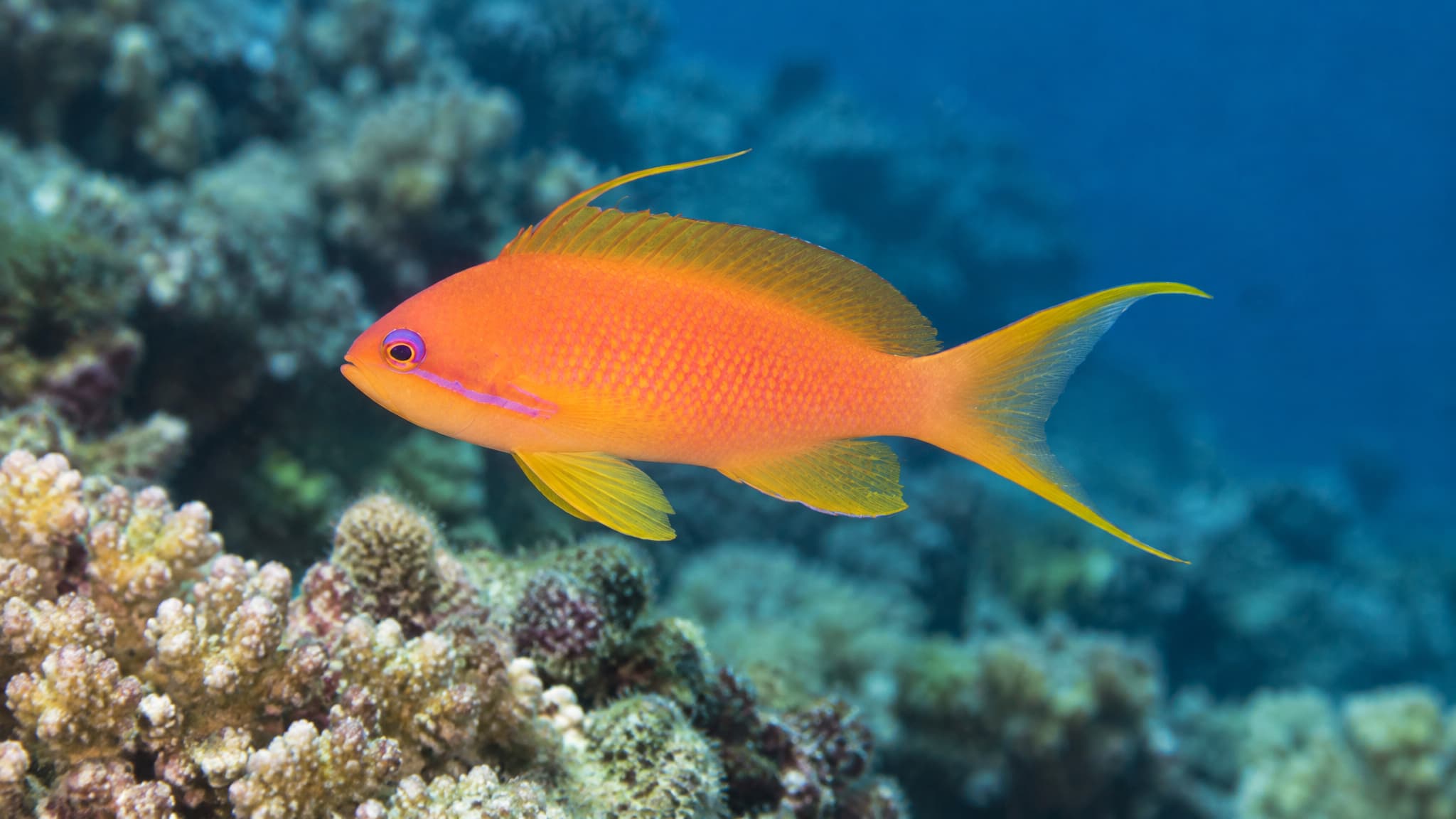
A bright orange Sea Goldie is shown in left-facing side profile, swimming above a coral reef. It has yellow fins, a purple stripe along the cheek, an elongated dorsal filament, and a deeply forked, lyre-shaped tail.
The sea goldie (Pseudanthias squamipinnis), also called the lyretail anthias, scalefin anthias or orange basslet, is a small, brightly coloured reef fish of the Indo-West Pacific. The sexes look very different. Females are yellow-orange, reach only about 7 cm and have an orange stripe running from the eye across the cheek. Males grow to roughly 15 cm, turn magenta to purplish, carry a reddish-purple patch on the pectoral fin and develop a long third dorsal-fin spine plus extended upper and lower tail lobes that give the lyre-shaped tail. The dorsal fin has 10 spines and 15–17 soft rays, and colour patterns vary from place to place.
The species ranges from the Red Sea and Natal, South Africa, east to Niue, north to Japan and south to Australia, where it occurs from the Great Barrier Reef to New South Wales and Lord Howe Island. It lives over coral outcrops and patch reefs in clear lagoons, channels and outer reef slopes, from near the surface to about 55 m, mostly at 5–35 m. Some ichthyologists suspect that populations across this range may include more than one species.
Sea goldies form large, shimmering aggregations above the reef, often along reef edges and drop-offs. They pick zooplankton from the water column and dart back into soft corals, holes and crevices when threatened.
The species is a protogynous hermaphrodite: every fish starts life as a female. Groups are built from harems of females controlled by territorial males. When a dominant male disappears, a large female can change sex within about two to four weeks; sex change typically happens at around 5 cm. Males spawn nightly with successive females and release eggs and sperm into open water, with no parental care. FishBase gives a generation time of about 1.8 years. Lifespan in the wild is poorly documented, and aquarium sources report about 5–7 years in captivity.
As abundant planktivores, sea goldies move energy from plankton into the reef food web. The IUCN lists the species as Least Concern. It supports minor commercial fisheries and is widely collected for the marine aquarium trade.
In collections
Ideal water
The water this fish does best in, as kept in aquariums.
- Water type
- Marine
- Temperature
- 22–28 °C
- pH
- 8.1–8.4
- alkaline
- Specific gravity
- 1.020–1.025