Sea slater
Ligia oceanica
 AI-generated
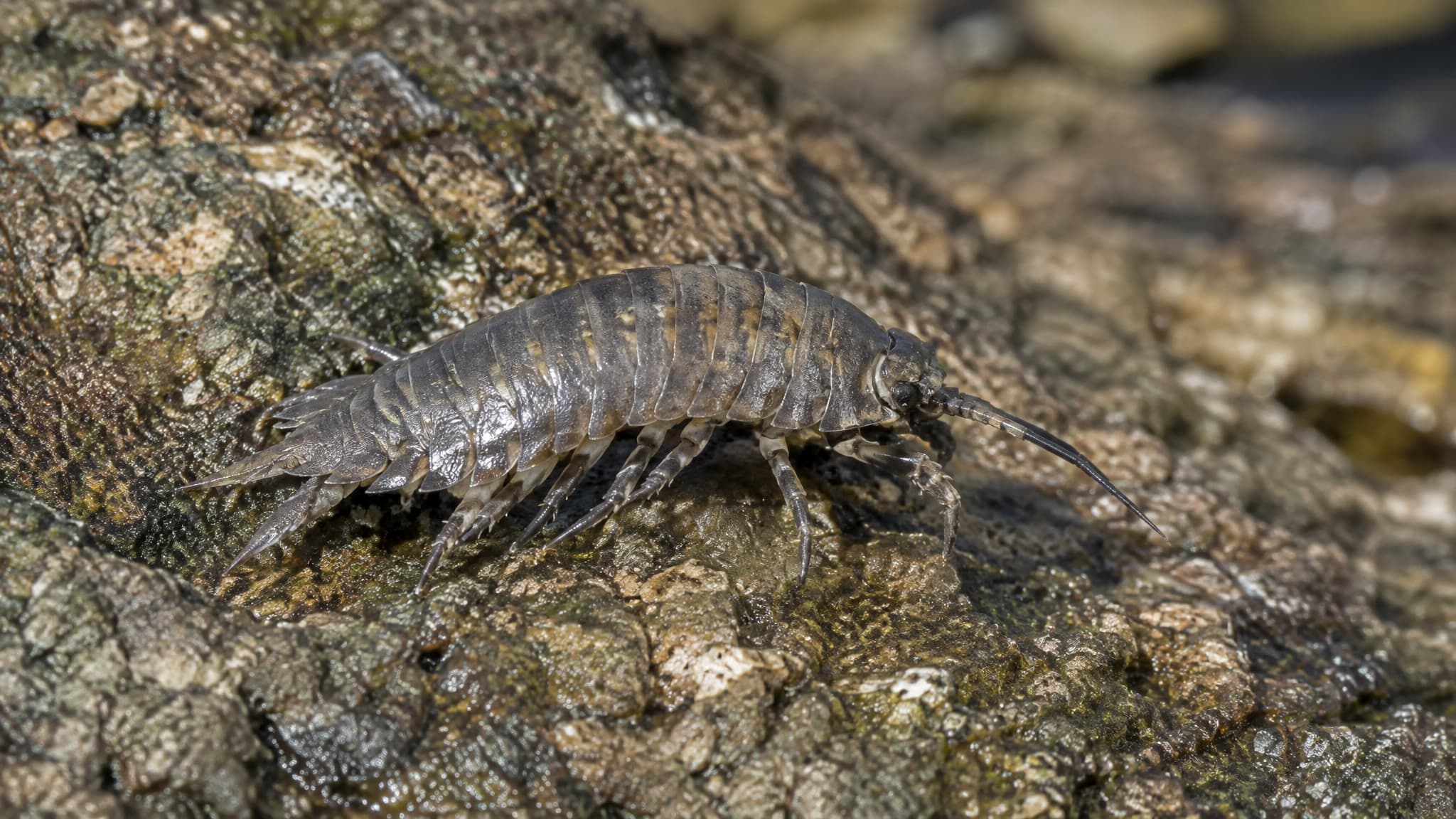
A Sea slater (Ligia oceanica) is shown in side view walking across a wet, algae-covered rock, with a distinctly segmented body, numerous legs, and long antennae visible. 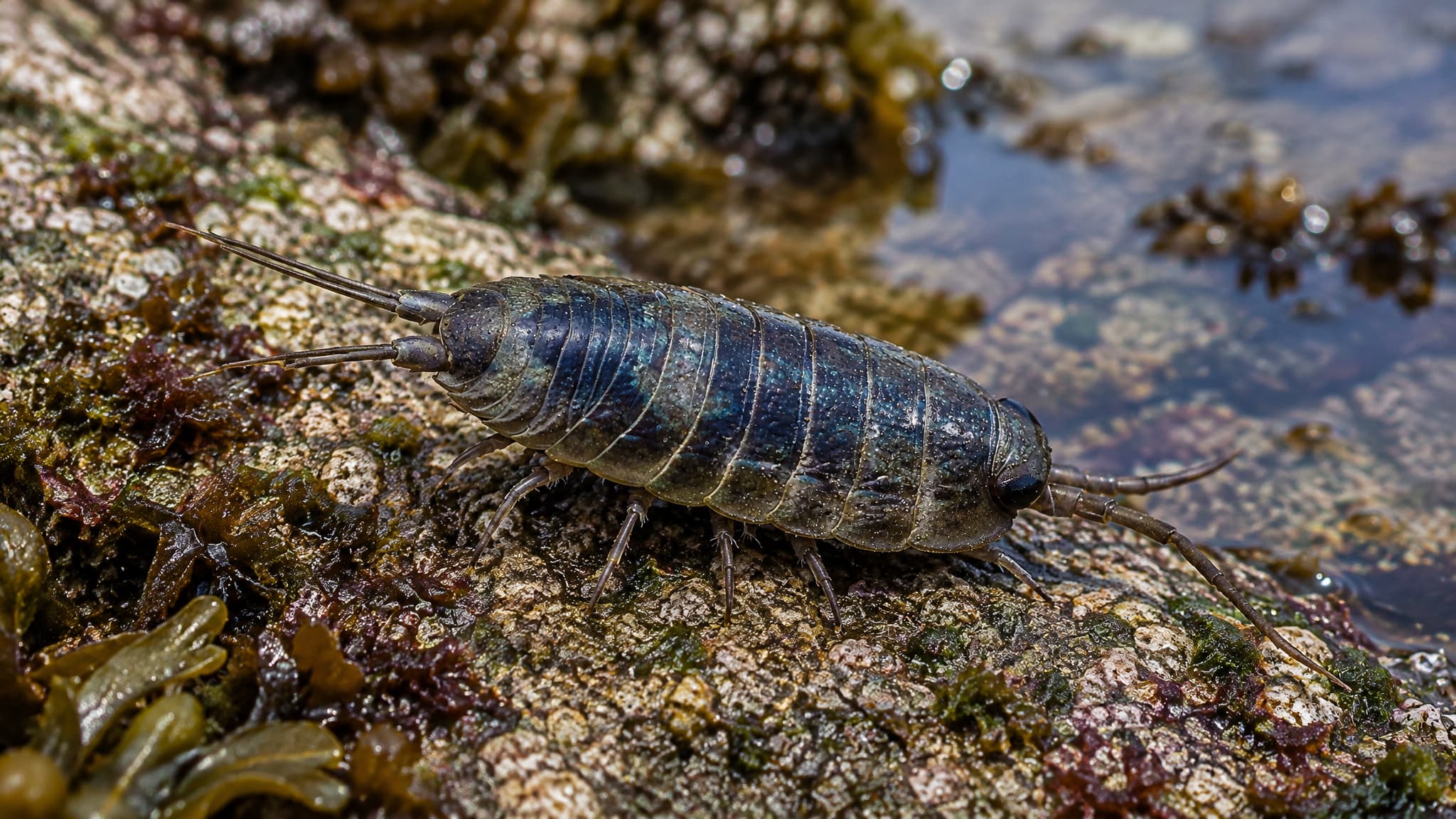 AI-generated
A dark blue-gray sea slater rests on algae-covered intertidal rock beside shallow seawater, showing a segmented oval body, long antennae, multiple walking legs, and paired tail appendages.
The sea slater (Ligia oceanica) is a large woodlouse-like crustacean of rocky seashores and is often described as the biggest member of the land isopods (Oniscidea), reaching about 3 cm and sometimes slightly more. Its oval body is flattened from top to bottom, roughly twice as long as it is wide, and coloured grey, brownish or olive. Large compound eyes with more than 40 facets, antennae about two-thirds the length of the body with a many-segmented flagellum, seven pairs of similar walking legs and a pair of long, forked uropods at the tail make it easy to tell apart from ordinary garden woodlice.
The species is native to the northeast Atlantic, from southern Norway to Morocco and into the western Baltic, with records from the Faroe Islands and southern Iceland. Around Britain and Ireland it is common along almost the entire coast wherever there is hard substrate. It has also been introduced to parts of the North American Atlantic coast, the Azores and the Canary Islands, probably with shipping. It lives in a narrow band from the splash zone to a few metres above high tide: cliff bases, boulder beaches, harbour walls and jetties, sheltering in crevices, rock pools and under stones.
Sea slaters are nocturnal and secretive. By day they hide in damp cracks, and at night they emerge to forage, moving with a speed and agility that makes them hard to catch. They breathe air yet still rely on moist rock for water and temperature balance. Their food is mostly algal: green and brown seaweeds such as bladderwrack, encrusting diatoms, and decaying seaweed and other plant debris washed onto the shore.
Breeding takes place in spring and summer. Females carry their eggs in a brood pouch (marsupium); in England a brood holds roughly 50 to 120 eggs, with larger females producing more. Young leave the pouch as mancae that still lack the last pair of legs. Most females breed only once. A long-term study of English populations found two breeding waves each year: larger, fast-growing females breed late in their first season, while smaller ones wait until early in their second year. Individuals live about 2.5 to 3 years.
By eating stranded seaweed and shore debris, sea slaters help break down organic matter at the boundary between land and sea, and they are likely prey for shorebirds, rats and raccoons. Molecular studies suggest the genus Ligia is closer to marine isopods than to other woodlice, making it an interesting model of the move from sea to land. The species has no global IUCN assessment, but it is widespread and listed as Least Concern in Great Britain.