Sergeant major
Abudefduf saxatilis
 AI-generated
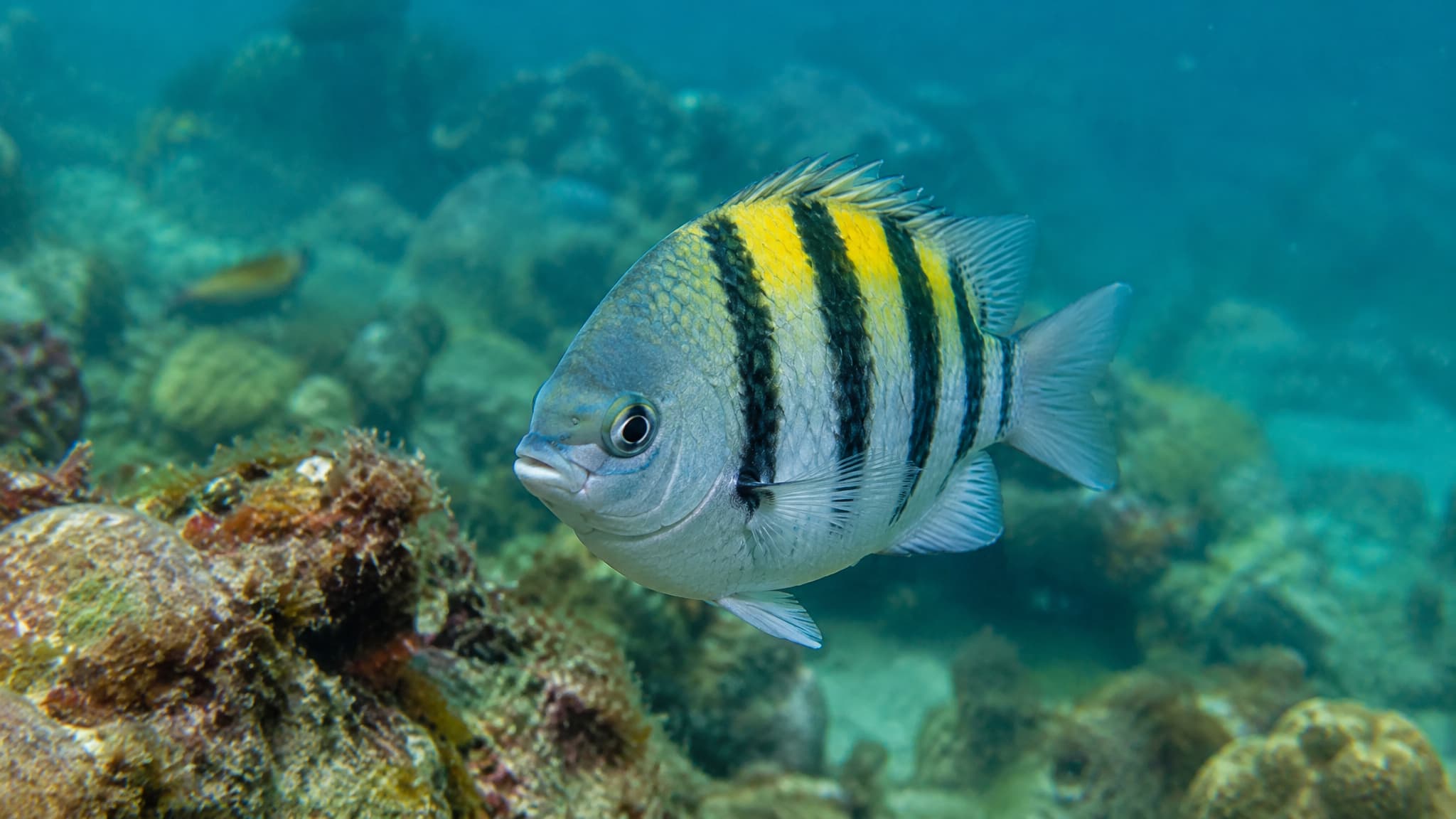
A Sergeant major swims leftward just above a coral-covered reef, with its silver body, yellow upper back, bold black vertical bars, large eye, raised dorsal fin, and translucent fins clearly visible.
Sergeant major
The sergeant major, Abudefduf saxatilis, is a conspicuous Atlantic damselfish named for the dark vertical bars resembling military insignia. Its body is deep, oval, and strongly flattened from side to side. Adults are usually silvery to bluish below, with a yellowish wash across the back and upper flanks, and five bold dark bars. Individuals can shift into a darker gray-blue color phase when sheltering in crevices. It reaches about 23 cm in maximum length, though many individuals are smaller.
This is a reef-associated marine fish of the Atlantic. Its native distribution spans the western Atlantic from the northeastern United States south through the Gulf of Mexico, Caribbean, and Brazil to Uruguay, and it also occurs around several central and eastern Atlantic islands and along the West African coast to Angola. It is chiefly an inshore species, using shallow coral and rocky reefs, jetties, tide pools, sandy reef margins, submerged structures, and floating objects. Juveniles may also use protected mangrove and nearshore nursery habitats.
Sergeant majors are active by day and often feed in conspicuous schools, sometimes numbering hundreds of fish. They are flexible omnivores and planktivores: algae and tiny organisms in the water column are important foods, alongside small crustaceans and other invertebrate material. At night, schooling fish disperse into holes and reef crevices. By grazing and consuming plankton, they help transfer energy through shallow-reef food webs; juveniles have also been documented participating in cleaning interactions.
Breeding males establish and defend nest sites on hard surfaces such as reef rock or wreck material. Females lay adhesive, bottom-attached eggs, and males remain to guard and fan the clutch, defending it vigorously from intruders. The eggs develop on the substrate, while later larval stages disperse in the plankton. The consulted references do not provide a dependable maximum lifespan for the species.
The IUCN assessment listed by FishBase classifies A. saxatilis as Least Concern. It is common in many parts of its broad range and has minor fisheries and aquarium relevance. Nevertheless, its dependence on productive coastal reefs means local populations can be affected by reef degradation, pollution, warming seas, and damaging human activity in shallow coastal habitats.