Siamese Fighting Fish
Betta splendens
 AI-generated
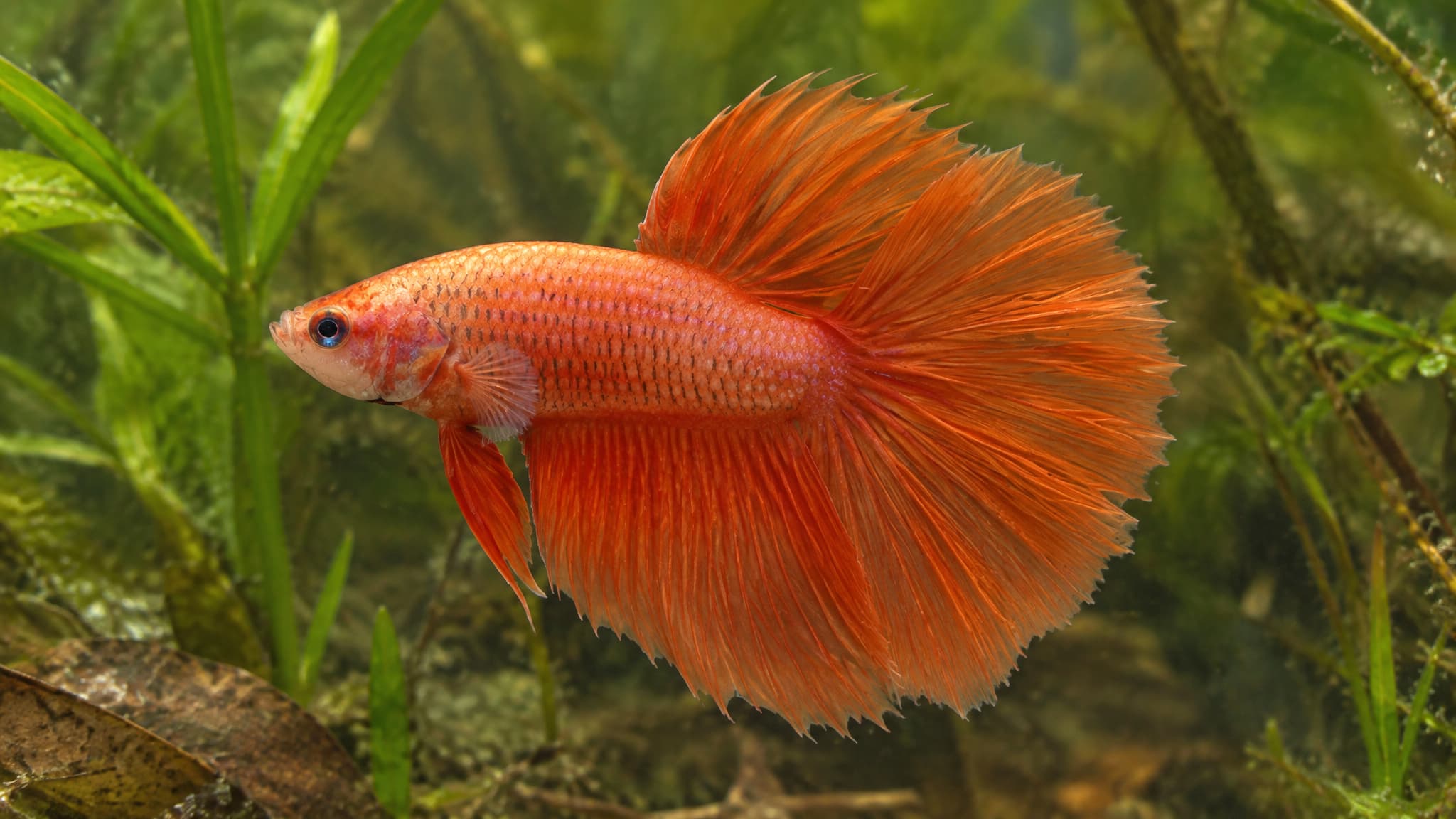
An orange Siamese fighting fish faces left in a planted aquarium, displaying an elongated body, rounded head, dark eye, and very long flowing dorsal, anal, and caudal fins.
The Siamese fighting fish (Betta splendens), widely known as the betta, is a small freshwater fish in the gourami family, Osphronemidae. Adults usually measure around 5–7 cm in total length; FishBase records a maximum of about 6.5 cm. Wild fish are fairly drab, with short fins and reddish or greenish tones. Centuries of selective breeding have produced the long-finned, brilliantly coloured males that are now among the most popular aquarium fish in the world, second only to the goldfish.
Distribution and habitat
The species is native to mainland Southeast Asia, including Thailand, Cambodia, Laos and Vietnam, around the Mekong basin. It lives in shallow, densely vegetated, still or very slow-moving waters such as rice paddies, floodplain marshes, ditches and stagnant pools. These waters are often warm and low in oxygen.
Diet and behaviour
Like other anabantoids, the betta has a labyrinth organ that lets it gulp air at the surface, so it can survive in oxygen-poor water. In the wild it feeds mainly on insects and insect larvae, especially those that fall onto the water surface. Researchers have described several feeding methods, including snapping, gulping, grazing, jumping and spitting. Males are famously territorial: they flare their gill covers and fins at rivals and will fight other males. Selective breeding for fighting in Thailand made this aggression even stronger.
Reproduction and lifespan
The male builds a bubble nest of mucus-coated air bubbles at the surface. After a courtship embrace, he collects the falling eggs in his mouth, places them in the nest and guards them. The fry hatch in about one to two days. FishBase gives a maximum reported age of about 2 years, which matches typical wild lifespans. Well-kept captive fish often live 2 to 5 years.
Ecological role and conservation
Bettas eat insects, including mosquito larvae, and are in turn eaten by larger fish, birds and other predators. Domesticated forms are common everywhere, but pure wild populations are declining because of habitat loss, agricultural change and pollution. The IUCN lists the species as Vulnerable.
In collections
Ideal water
The water this fish does best in, as kept in aquariums.
- Water type
- Freshwater
- Temperature
- 24–30 °C
- pH
- 6.0–8.0
- acidic to alkaline
- General hardness
- 5–19 dGH