South American lungfish
Lepidosiren paradoxa
 AI-generated
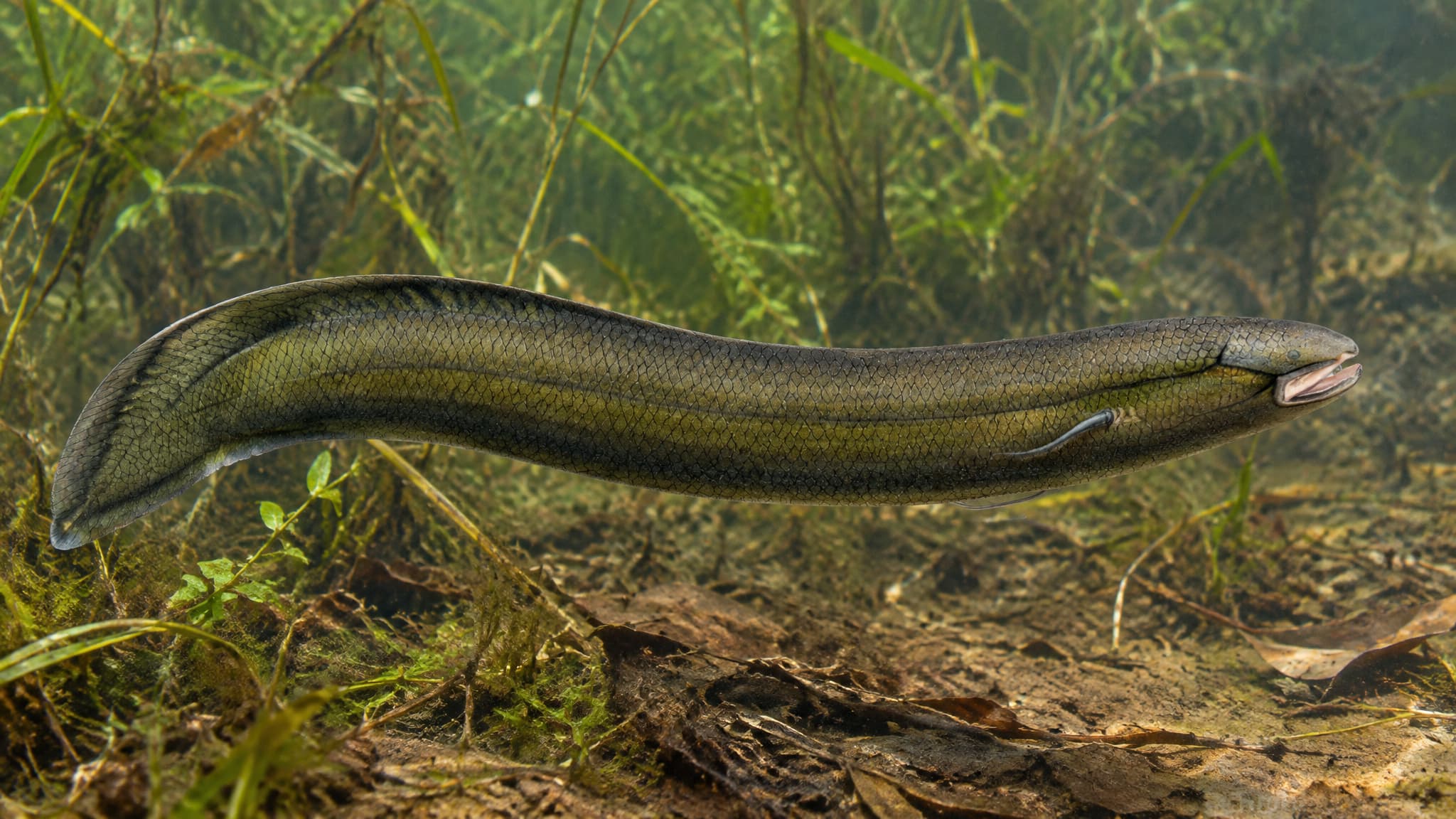
An elongated South American lungfish is shown in side profile, held nearly horizontal above a vegetated, muddy freshwater bottom. Its scale-covered body, rounded tapering tail, small eye, open mouth, and thin filament-like appendage are visible.
The South American lungfish (Lepidosiren paradoxa) is the only member of its genus and one of the few living lungfishes. Its body is long, slender and almost eel-like, with a flattened head, thread-like paired fins and a diphycercal tail. Adults are dark grey or black, while juveniles are marked with bright yellow or gold spots that fade as they grow. It can reach 125 cm in length.
The species lives in the Amazon, Paraguay and lower Paraná river basins, with records from Brazil, Argentina, Bolivia, Colombia, French Guiana, Paraguay, Peru and Venezuela. It favours stagnant or slow-moving water such as swamps, weedy creeks and floodplain lakes, often shallow and poor in oxygen, and many of these places dry out completely in the dry season.
Unlike most fish, it is an obligate air-breather: it must rise to the surface to gulp air with its lungs and can drown if it cannot reach it. When its pool dries up, it digs into the mud to a depth of about 30–50 cm, leaving small openings to the surface for air. There it seals itself in mucus and greatly slows its metabolism, a dormant state called aestivation, until the rains return. It is solitary and mostly inactive.
Young lungfish feed on insect larvae and snails. Adults are omnivorous, taking snails, clams, shrimp, insects and small fish as well as algae and plant material, which they crush with heavy, mineralised tooth plates. Prey is captured by suction.
Breeding starts with the rainy season. The pair builds a nest in a burrow lined with plant debris, and the male guards the eggs and young. During this period he grows feathery, blood-rich filaments on his pelvic fins that release extra oxygen into the nest water. The larvae resemble tadpoles and carry four external gills, switching to air-breathing at about seven weeks. Recorded lifespans average about 8 years, although captive fish have lived well over 20 years.
The IUCN lists the South American lungfish as Least Concern. Beyond its role as a predator of snails and other invertebrates, it is of great scientific interest, because lungfishes help explain how vertebrates made the move from water to land.
Ideal water
The water this fish does best in, as kept in aquariums.
- Water type
- Freshwater
- Temperature
- 24–28 °C
- pH
- 6.0–8.0
- acidic to alkaline
- General hardness
- 2–20 dGH