Southern Platyfish
Xiphophorus maculatus
 AI-generated
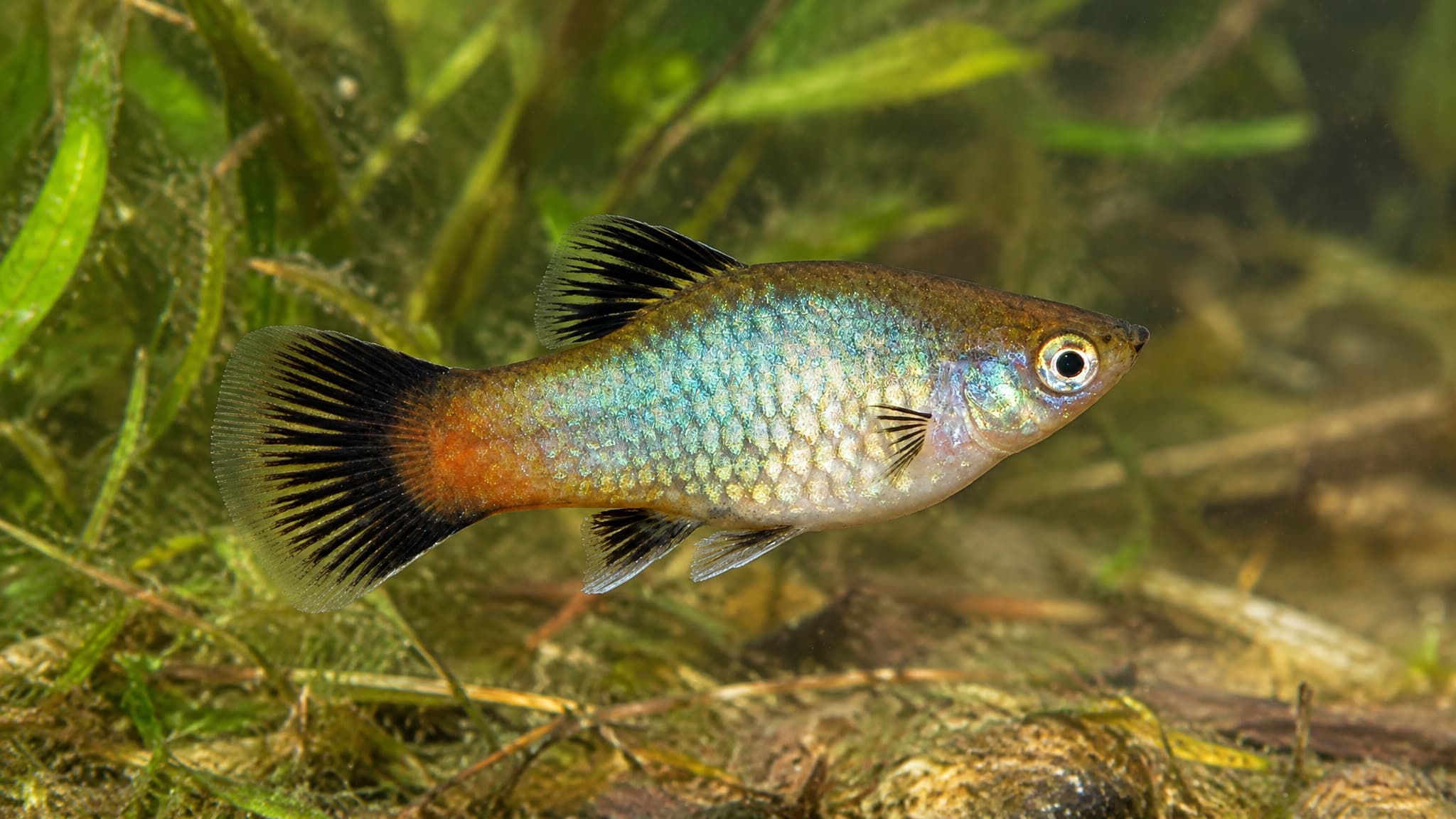
A Southern Platyfish is shown in right-facing side profile, swimming among submerged aquatic plants and substrate; its iridescent body, large dark-striped dorsal and caudal fins, and translucent paired fins are clearly visible.
The southern platyfish (Xiphophorus maculatus), also called the common platy or moonfish, is a small live-bearing fish in the family Poeciliidae. Günther described it in 1866. It has a deep, compressed body with an arched back, a small triangular head and an upturned mouth. Adults usually reach about 4 to 6 cm. Wild fish are fairly plain, with variable black markings. Aquarium breeding over more than a century has produced dozens of color forms, from red and gold to blue and black. Unlike their swordtail relatives, males never grow a sword on the tail. In males, the anal fin is modified into a pointed gonopodium, while females keep a fan-shaped anal fin.
Distribution and habitat
The species is native to the Atlantic slope of North and Central America, from around Veracruz in Mexico to northern Belize, with records from Guatemala and Honduras. It lives in warm springs, canals, ditches, creeks and swamps with slow water, silty bottoms and weedy banks. Releases from fish farms and aquariums have established it far outside its native range, including parts of the United States, Queensland in Australia, India and southeastern Brazil.
Diet and behavior
The platy is an omnivore. It eats worms, small crustaceans, aquatic and land insects, and plant matter. In streams in Queensland, introduced platies ate mostly crustaceans, especially atyid shrimp, along with insects. It is peaceful, active and often found among dense vegetation.
Reproduction and lifespan
Fertilization is internal, and females give birth to fully formed young. After a gestation of about 24 to 30 days, a female may produce 20 to 80 fry, and she can have several broods a season. Its population resilience is high, because it can mature in under a year. In aquariums, platies usually live about 2 to 4 years.
Ecological role and scientific importance
In its native waters, the platy eats small invertebrates and is prey for larger fish and birds. Where it has been introduced, it can harm local wildlife: it has been linked to the decline of native damselflies in Hawaii and can dominate fish communities in weedy habitats. It is also an important lab animal. It is used in genetics and cancer research, its genome was sequenced in 2013, and it has an unusual sex-determination system involving W, X and Y chromosomes.
Conservation
The IUCN lists X. maculatus as Data Deficient. It is widespread and very common in the aquarium trade, and its introduced populations are treated as a concern for invaded ecosystems.
In collections
Ideal water
The water this fish does best in, as kept in aquariums.
- Water type
- Freshwater
- Temperature
- 18–25 °C
- pH
- 7.0–8.0
- neutral to alkaline
- General hardness
- 9–19 dGH