Stoplight Parrotfish
Sparisoma viride
 AI-generated
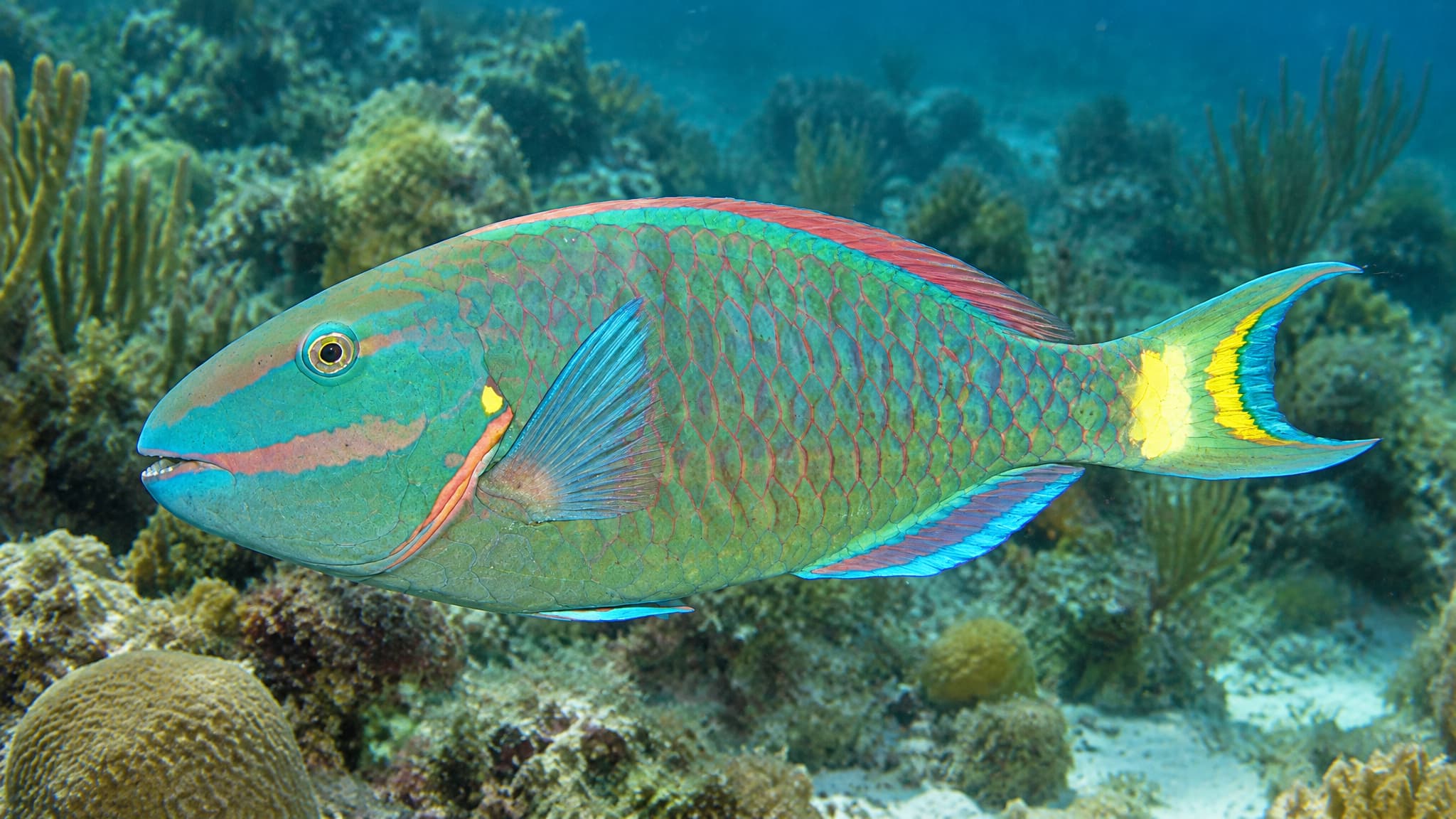
A Stoplight Parrotfish swims left in side profile above a coral reef, showing a robust turquoise-green body, red-edged scales, a beak-like mouth, and vivid blue, yellow, and red fins and tail.
Stoplight Parrotfish
The stoplight parrotfish (Sparisoma viride) is a large, colorful parrotfish of the tropical western Atlantic. Like other parrotfishes, its teeth are fused into a strong beak. In the genus Sparisoma, the lower teeth fit inside the upper ones. The species goes through distinct color phases. Juveniles are mottled. Initial-phase fish have a reddish belly and a pale, scaly-patterned body. Terminal-phase males are mostly green with bright yellow and orange marks, including the yellow spot near the pectoral fin that gives the fish its common name. Most adults are 30–50 cm long, and the largest recorded fish reach about 64 cm.
Distribution and habitat
The species ranges from Bermuda and Florida through the Gulf of Mexico and the Caribbean south to Brazil. It lives on coral reefs, usually in clear water 3–50 m deep. Adults are most common on shallow reef bases and slopes. Juveniles shelter among branching finger coral and sometimes in seagrass beds.
Diet and behavior
The stoplight parrotfish feeds almost entirely on algae. Instead of just scraping the surface, it bites into dead coral skeletons to reach the algae inside, and its teeth keep regrowing. Adults stay in one area. Males defend territories of roughly 100–300 m², and a fish's daily feeding range covers about 50–800 m².
Reproduction and lifespan
The species is a protogynous hermaphrodite: many individuals start life as females and later change into terminal-phase males. Spawning happens all year in deeper reef areas, and fertilization is external. Large males keep harems of about 3–7 females. Smaller primary males may spawn in groups. Fish mature at about four years old. Wild individuals typically live 7–12 years, and some have reached about 30.
Ecological role and conservation
The stoplight parrotfish is abundant, and its grazing keeps algae from smothering corals. Its feeding also wears down coral rock and turns it into sand. Predators include snappers, jacks and moray eels. People also fish it for food. The IUCN lists it as Least Concern, but fishing pressure and reef degradation are local concerns.