Surinam toad
Pipa pipa
 AI-generated
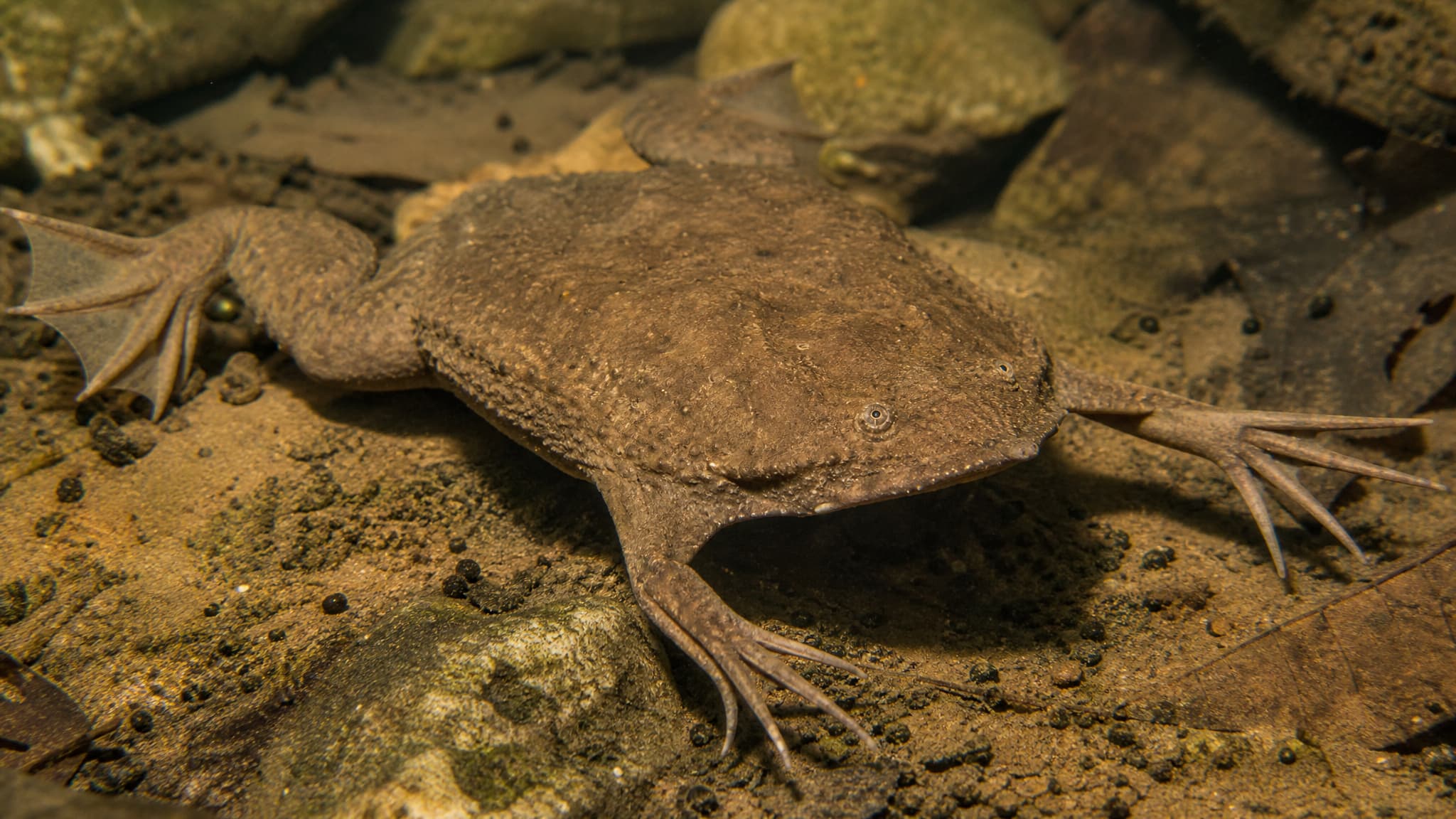
A brown, flattened Surinam toad rests on a rocky streambed, with small eyes set high on its head, broad webbed hind feet, and long splayed digits visible around the body.
The Surinam toad is an unmistakable, fully aquatic frog with an extremely flat, broad body, a triangular head, and tiny lidless eyes positioned high on the head. Its brown to olive skin, often marked with darker mottling, helps it disappear against mud and leaf litter. Adults are commonly about 10.5–17 cm long, and the front fingers end in distinctive star-like sensory organs.
It occurs across tropical northern and central South America, from the Amazonian lowlands into the Guianas and Trinidad. Rather than living on land like many frogs, it occupies quiet, muddy freshwater habitats including ponds, swamps, slow rivers, canals, and flooded forest. It normally remains submerged, surfacing periodically to breathe.
This species hunts chiefly at night or from still ambush positions. Tongueless and toothless, it uses its sensitive fingertips to locate worms, aquatic insects, crustaceans, and small fish, then draws prey into its mouth by suction or manipulates it with its forelimbs. By feeding on small aquatic animals, it is both a predator in freshwater food webs and potential prey for larger aquatic predators.
Its reproduction is especially notable. During underwater courtship, a male clasps a female and the pair performs repeated somersaults; fertilized eggs are pressed into the female's back, where skin forms individual brood chambers around them. Young undergo direct development rather than a free-swimming tadpole stage and emerge roughly three to four months later as miniature toads. Captive animals have been reported to live around eight years; wild longevity is less well documented.
Pipa pipa is generally assessed as Least Concern because of its broad range, but wetland degradation and forest conversion for agriculture, ranching, and logging can damage the calm freshwater habitats on which it depends. Molecular research also indicates that populations currently called Pipa pipa may conceal several distinct species, so continued taxonomic and field study is important for interpreting its distribution and conservation needs.