Tiger barb
Puntigrus tetrazona
 AI-generated
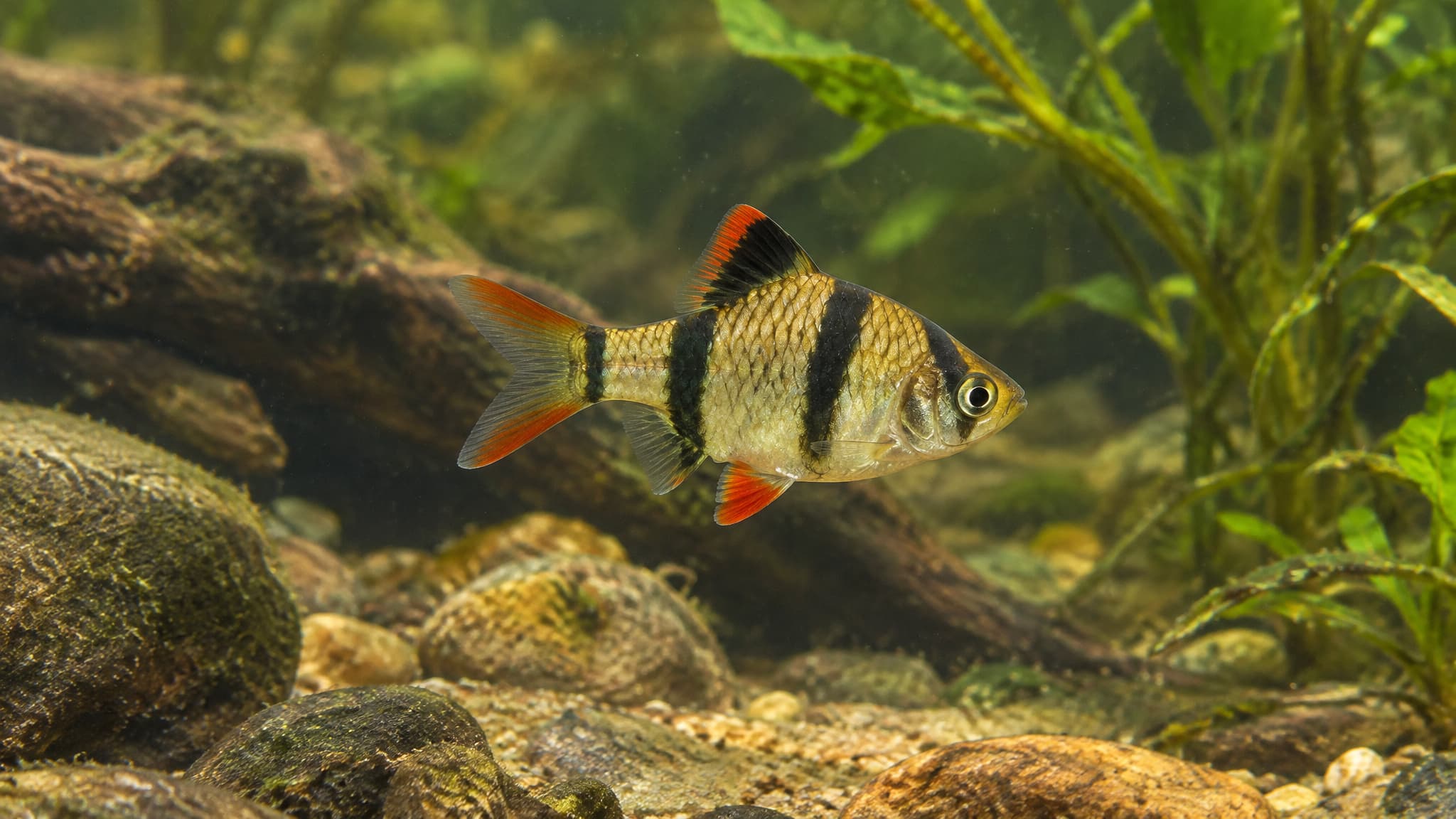
A tiger barb (*Puntigrus tetrazona*) is shown in right-facing side profile, swimming above a rocky substrate in a planted aquarium with driftwood. Its golden body has four prominent dark vertical bands and orange-red fins.
The tiger barb, also called the Sumatra barb (Puntigrus tetrazona), is a small fish in the carp and minnow family (Cyprinidae). It grows to about 7 cm in total length. Its deep, flattened body is golden to silvery, with four bold black vertical bars: one runs through the eye and one sits near the base of the tail. The fins and snout often have red or orange tints. Bleeker described the species in 1855. It was later placed in Capoeta, Barbus, Puntius and Systomus before moving to Puntigrus, a genus created in 2013.
Wild tiger barbs probably live only in central and southern Sumatra, Indonesia, with records from the Indragiri, Batang Hari and Musi river systems. Older reports from Borneo are now thought to refer to related species. It is a tropical freshwater fish that swims in the middle and lower water layers. Its natural habitat is poorly documented, but close relatives prefer forest streams with fairly clear water over sand, pebbles and rocks.
Tiger barbs eat both animal and plant food, including worms, small crustaceans and plant matter. In aquariums they accept good-quality dried foods along with small frozen or freeze-dried prey such as bloodworms and Artemia. They are lively schooling fish and do best in groups of five or more. Kept in small numbers they can become territorial, and they are well known for nipping the fins of slow, long-finned tankmates.
Like most small cyprinids, the species scatters its eggs and gives no care to its young. Aquarium sources report an average lifespan of about seven years. Almost all tiger barbs in the pet trade are farmed, and breeders have developed ornamental forms such as the moss-green tiger barb. It is still debated whether these farmed fish are the same as wild Sumatran stock, and inbreeding has left many of them weak or deformed.
The IUCN lists the tiger barb as Least Concern. The aquarium trade has carried it to many countries, and it has become established in some, including Puerto Rico and Colombia, though no ecological harm has been documented. FishBase estimates its trophic level (its position in the food chain) at about 2.9, which makes it a mid-level feeder on both plants and animals in its native waters.
In collections
Ideal water
The water this fish does best in, as kept in aquariums.
- Water type
- Freshwater
- Temperature
- 20–26 °C
- pH
- 6.0–8.0
- acidic to alkaline
- General hardness
- 5–19 dGH