Banded archerfish
Toxotes jaculatrix
 AI-generated
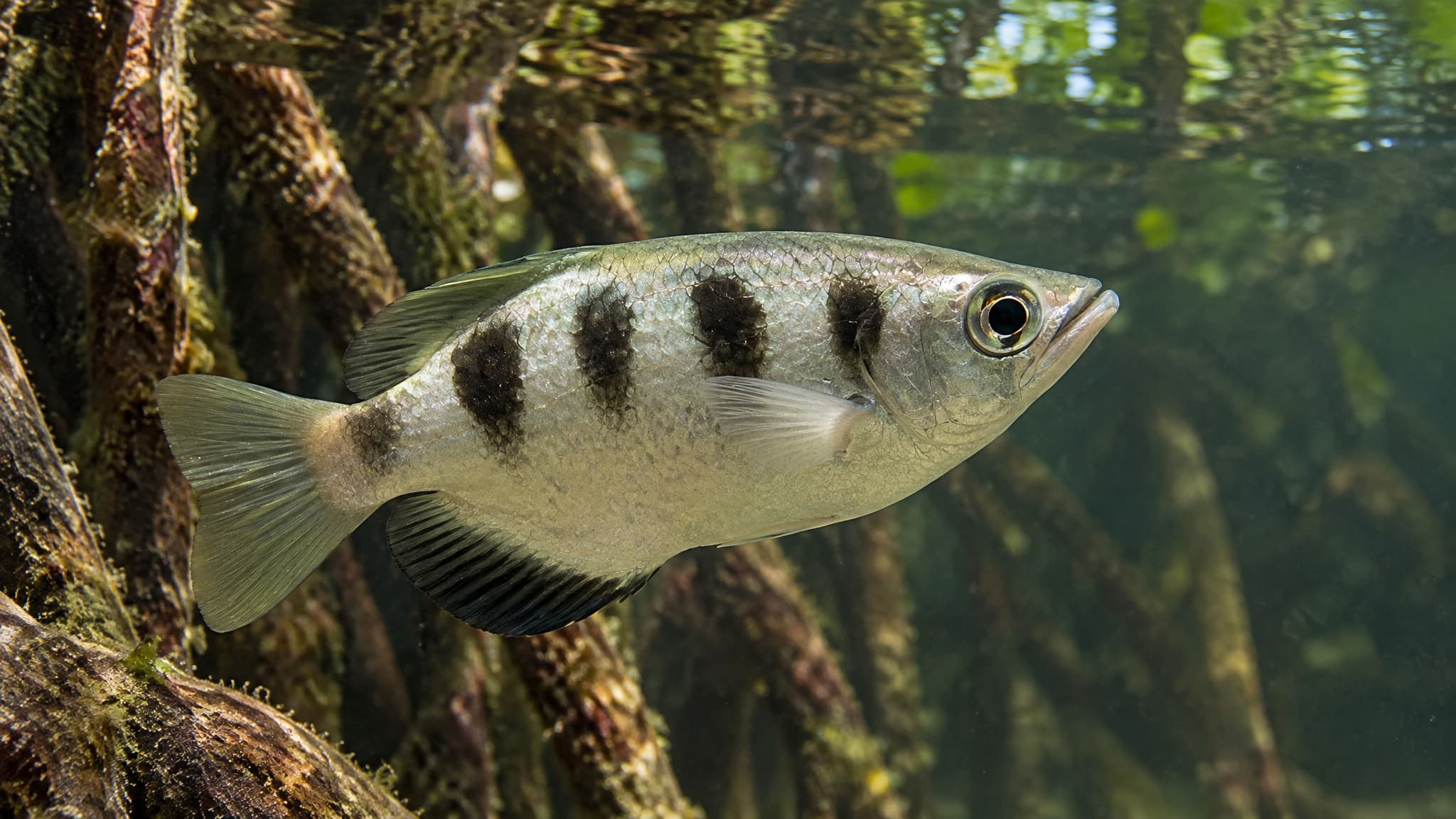
A banded archerfish is shown in side profile, swimming through clear, shaded water among submerged mangrove-like roots. Its silvery body has several bold dark vertical bands, translucent fins, and a prominent upturned mouth.
The banded archerfish (Toxotes jaculatrix) is famous for knocking insects off leaves with a precise jet of water. Described by Pallas in 1767, it usually measures about 20 cm, with a maximum length of about 30 cm. The body is deep and flattened, silvery, with an olive-green or brownish back and four to six broad black bars across the upper sides. The dorsal fin sits far back on the body, and the large, forward-facing eyes give it binocular vision for judging targets above the surface.
The species ranges across the Indo-Pacific, from India east to the Philippines and south through Indonesia to Papua New Guinea, the Solomon Islands, Vanuatu and northern Australia. Its main home is brackish mangrove swamps and estuaries, usually in shaded water under dense overhanging vegetation, but it also enters rivers, streams, lakes and ponds. It moves between fresh and salt water and usually lives in small groups.
Archerfish feed at the surface during the day. They take floating debris, plant matter and insects, and also eat crustaceans and small fish. To reach prey on branches, it fires a stream of water from its mouth, with a typical range of about 150 cm; large adults can reach 2 to 3 m. It can arrive at fallen prey within about 50 milliseconds, and it also leaps from the water to grab prey directly. Young fish appear to improve their aim partly by watching other archerfish.
Breeding begins at a length of about 10 cm, and a female can release 20,000 to 150,000 eggs in a spawning. Breeding in captivity is rare, and details of spawning in the wild are still poorly known. In aquariums the species typically lives 5 to 8 years and occasionally 9 to 10.
As an abundant surface predator of insects that fall from mangrove foliage, the archerfish links the forest canopy with the aquatic food web. The IUCN lists it as Least Concern, and it is fairly common. Loss of mangrove habitat and pollution are its main threats, and it is taken in small fisheries and for the aquarium trade. In captivity it needs warm brackish water of 25 to 30 °C, a large tank and a tight lid, since it jumps well.
Ideal water
The water this fish does best in, as kept in aquariums.
- Water type
- Freshwater
- Brackish
- Temperature
- 25–30 °C
- pH
- 7.0–8.0
- neutral to alkaline
- General hardness
- 20–30 dGH