Water Louse
Asellus aquaticus
 AI-generated
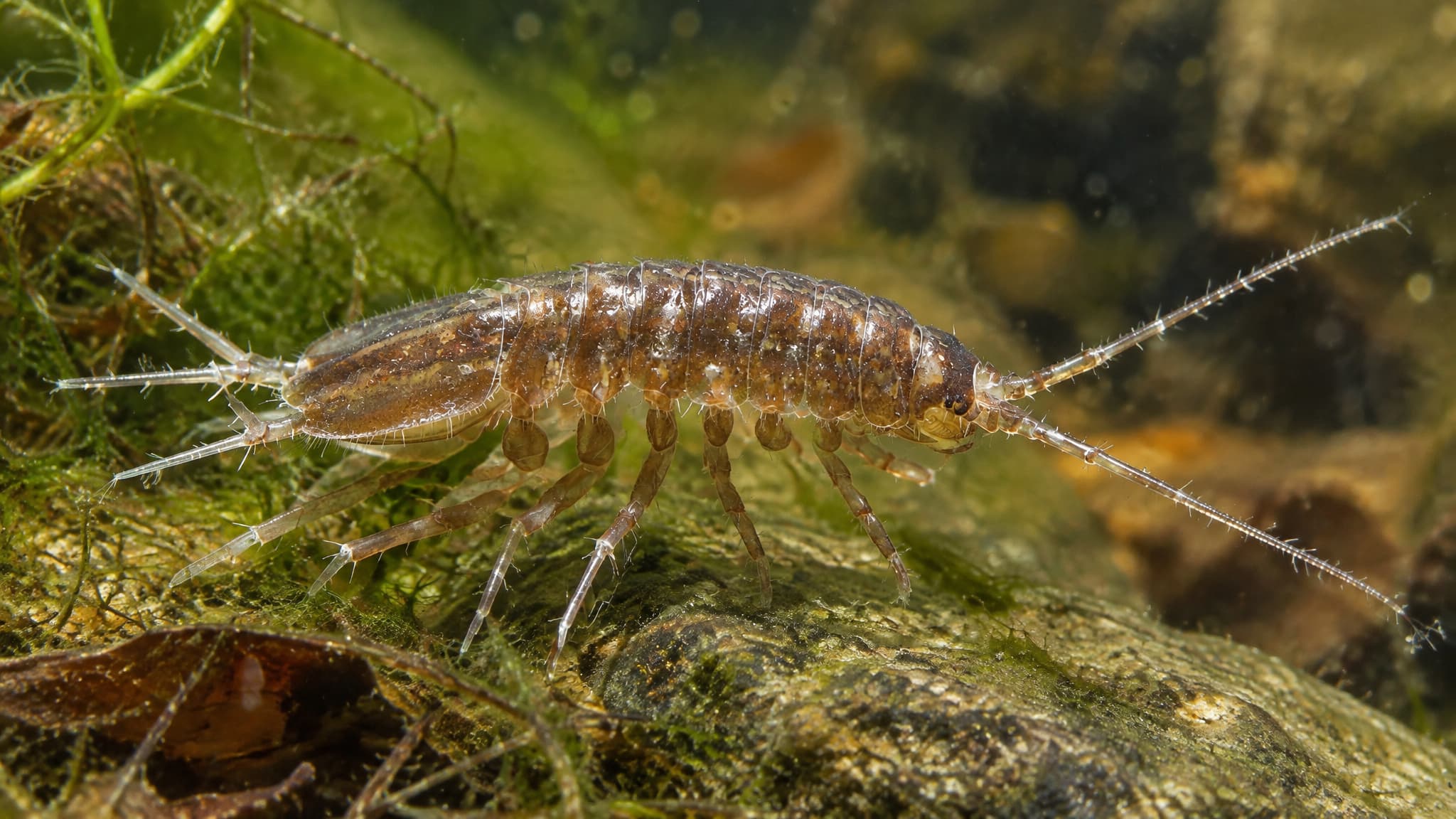
A water louse is shown in side profile walking across algae-covered submerged stones, with a flattened, distinctly segmented body, long antennae, and numerous jointed legs visible. The surrounding aquatic vegetation and water are softly blurred.
The water louse (Asellus aquaticus), also called the pond slater, water hoglouse or aquatic sowbug, is a freshwater isopod crustacean and a close relative of the land-dwelling woodlice. Its flattened body is roughly three times longer than wide and reaches up to about 2 cm, although many adults are half that size or less. It has two pairs of antennae, the longer pair nearly as long as the body, seven pairs of walking legs and a forked pair of tail appendages. Two pale spots on the back of the head usually separate it from the similar Proasellus meridianus, which has a single bar-shaped mark.
The species is widespread across Europe, from Britain, Ireland and the Iberian Peninsula east into western Russia and north to Scandinavia, and also occurs in parts of Asia. It lives in lakes, ponds, canals, ditches, rivers and streams, including small garden ponds, hiding under stones, among water plants, in leaf litter and under submerged wood. Some populations live in karst caves, where they have independently evolved reduced eyes, pale bodies and longer appendages.
The water louse is a detritivore that feeds on decaying leaves, biofilm, fungi, algae and soft plant shoots, preferring litter already colonised by microbes. It swims poorly and mostly crawls over weed and mud. It tolerates low oxygen and organic pollution better than many freshwater invertebrates, which is why it is used as an indicator of water quality.
Before mating, a male carries and guards a female for several days until she moults, because she can be fertilised only during a window of about 24 hours. Eggs develop in a brood pouch under the female's body; larger females carry more eggs, from a few dozen to over a hundred. Young leave the pouch at about 1 mm long. Populations often produce two generations a year, and lifespan ranges from about 9 months in southern Europe to about 20 months in northern Europe.
By breaking down dead plant material, the water louse recycles nutrients in freshwater ecosystems and is an important prey for fish, insects and waterfowl. The species has no global IUCN assessment and is considered common and of Least Concern in Britain, but several cave-dwelling subspecies from Slovenia and Italy have been listed as endangered.