West Indian Ocean coelacanth
Latimeria chalumnae
 AI-generated
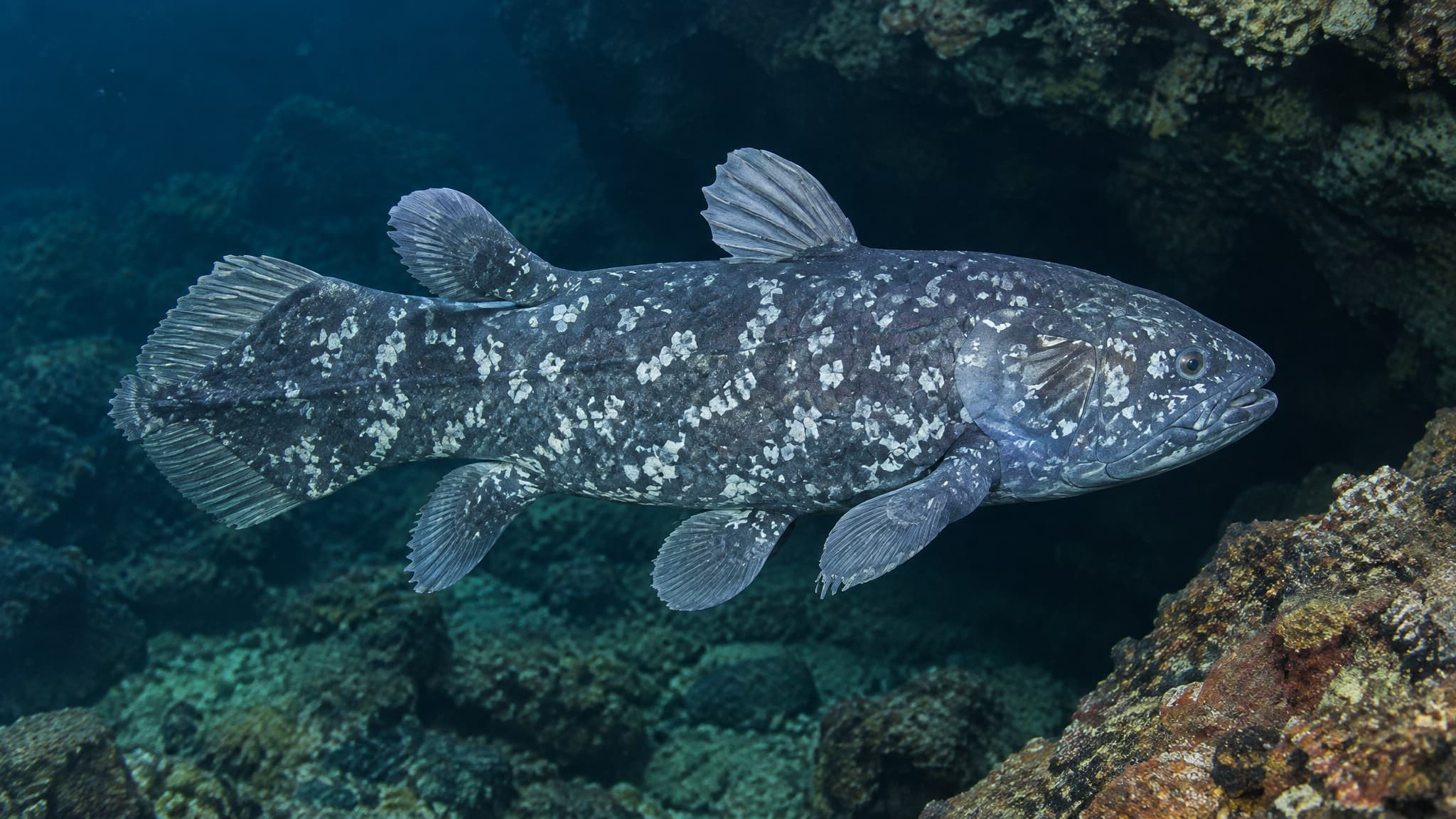
A West Indian Ocean coelacanth (Latimeria chalumnae) swims horizontally over a rocky underwater reef, with paired lobed fins, a broad tail, and mottled blue-gray body clearly visible.
The West Indian Ocean coelacanth (Latimeria chalumnae) is one of only two living coelacanths, a lineage of lobe-finned fishes long known only from fossils. Females reach about 2 m in length and males about 1.68 m, with a maximum recorded weight of 95 kg. Living fish are deep blue with irregular white blotches whose pattern is unique to each individual; the colour turns brown after death. Seven of its fins have fleshy, limb-like lobes, and the paired pectoral and pelvic fins move in a diagonal sequence similar to the gait of a four-legged animal. A rostral organ in the snout is thought to sense electric fields.
The species lives along the rim of the western Indian Ocean. Its best-known population is on the steep volcanic slopes of Grande Comore and Anjouan in the Comoros, and smaller groups are known from Kenya and Tanzania south to Mozambique, Madagascar and South Africa. By day coelacanths rest in lava caves at roughly 100 to 200 m depth, in water of about 16 to 22 °C, sometimes with more than a dozen fish sharing one cave.
At night each fish leaves the cave alone to forage over the bottom at depths of 70 to 700 m and sometimes covering up to 8 km before returning at dawn. It is an opportunistic predator that snaps up fishes, such as Beryx splendens, and also takes squid and other molluscs. Some individuals have been seen performing headstands, apparently probing crevices for prey.
Reproduction is ovoviviparous: eggs up to 9 cm across develop inside the female, who gives birth to between 5 and 26 fully formed young up to about 35 cm long. Gestation estimates range from about 13 months to 3 years. Growth is extremely slow; females are thought to mature only after more than 20 years, and a 2021 study suggests the species can live close to 100 years.
The coelacanth became famous in 1938, when a specimen caught off East London, South Africa, reached museum curator Marjorie Courtenay-Latimer; ichthyologist J. L. B. Smith described it in 1939 and named it after her and the Chalumna River area. The IUCN lists it as Critically Endangered and it is on CITES Appendix I. The total population is believed to number only in the hundreds, and accidental capture in deep-set fishing gear and gill nets is the main threat.