Green swordtail
Xiphophorus hellerii
 AI-generated
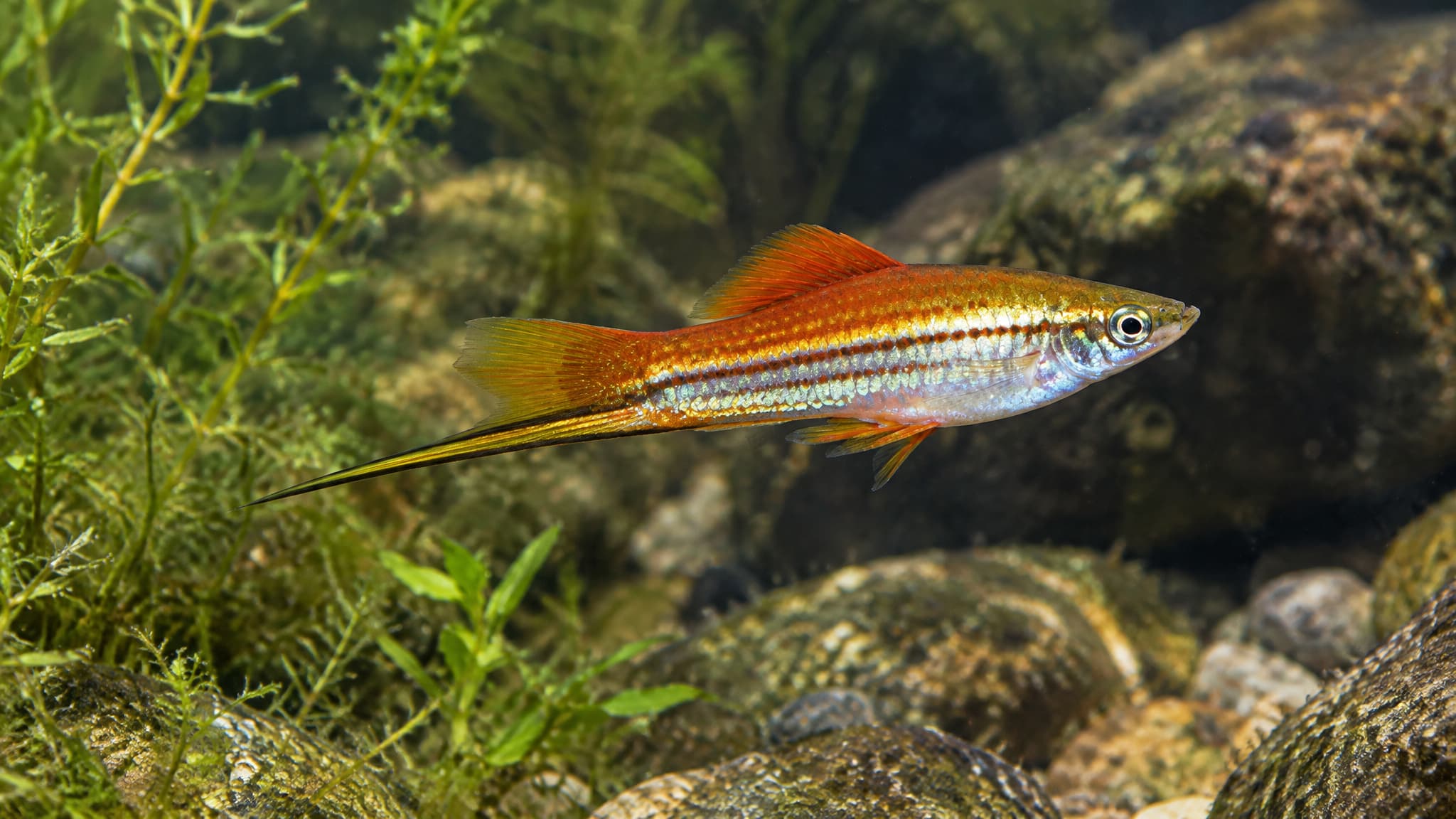
A Green swordtail swims in side profile through a planted aquarium, with rocks in the background and a long sword-like extension on the lower caudal fin. Its body is orange-green with iridescent lateral markings and orange fins.
The green swordtail (Xiphophorus hellerii) is a small livebearing fish of the family Poeciliidae, described by Heckel in 1848 from Orizaba, Mexico. Wild fish are olive green with a red or brown stripe along the flank and speckles on the dorsal fin. Adult males carry the feature that gives the species its name: an extended lower lobe of the tail fin, the "sword", yellowish and edged in black below. Males reach up to 14 cm in total length and females up to 16 cm. The name is often misspelled X. helleri.
The species is native to the Atlantic slope of Mexico and Central America, from the Río Nantla in Veracruz through central Guatemala and southern Belize to northwestern Honduras, from sea level to around 1,500 m. It lives in fast-flowing rocky streams and rivers, springs, canals, ditches and ponds, usually in water less than 1.5 m deep. Adults favour the current, while juveniles keep to quieter margins.
The green swordtail is an omnivore that feeds on worms, small crustaceans, insects and other aquatic and terrestrial invertebrates, along with algae, plant matter and organic detritus. In confined spaces males form dominance hierarchies and can be aggressive towards one another. The species is a well-known laboratory model for studies of female mate choice and male competition.
Like other poeciliids it bears live young. Males fertilise females internally with the gonopodium, a modified anal fin, and females can store viable sperm for months. After a gestation of 24 to 30 days a female gives birth to 20 to 200 young. Sources differ on age at maturity, from about 3 months to 8 to 12 months. Females can sometimes change sex to male. Lifespan is reported at up to 5 years.
Selective breeding and hybridisation with platies have produced red, black and many other ornamental strains, making it one of the most popular aquarium fish. Escaped and released fish have founded feral populations on every continent except Antarctica, including Brazil, southern Africa, Madagascar, Hawaii and eastern Australia, where they breed quickly and harm native species and ecosystems. In its native range the IUCN lists it as Least Concern.
Ideal water
The water this fish does best in, as kept in aquariums.
- Water type
- Freshwater
- Brackish
- Temperature
- 22–28 °C
- pH
- 7.0–8.0
- neutral to alkaline
- General hardness
- 9–19 dGH